Tuesday, July 21, 2009
Learning
Did You Know: The late submission deadline for Correspondence No. 3 has been extended indefinitely. We remain very welcoming of your work, please understand. Interested parties are invited to peruse the submission guidelines available on our (minimally designed) website for more details about what we’re looking for. Also, copies of Correspondence No. 2 are still available for purchase. Please consider spending a little of your milk money on this affordable collection of sophisticated new works of poetry, critical writing, fiction, and hybrid material (including a Möbius strip, don’t you know). This deal can be got through our online store. The Corresponding Society relies on earning enough money from the current issue to publish the next book. Helping us is a sexy way to support new writing and includes the bonus of an attractive perfectbound volume filled with uses of language better than a trip to Disneyland. We are beginning editorial work on issue 3 --- and are very confident in our ability to architect an even more engaging collection of letters --- but we feel slightly starved for different kinds of support from interested readers, writers, and correspondents beyond the team that manages and assembles the journal (and our immediate friends). We require activity from around places to eat like a meal. This is so because we undertake our labors to always expand creative discourse, rather than wallow in some private grumpiness. We want attention and money (read “want” as “need to continue this project”) but, more importantly, we want to expand the edges of our discourse through more participation, more conversation, more art. That is a lofty goal, but we try anyway. Beyond the publication of our journal, our public events, and website features such as the author catalog and library (not to mention the blog) we are developing in new ways --- including the release of our first chapbooks, from the No Know series curated by Robert Snyderman and built by a group of dedicated bookmakers. Please look forward to the birth, in the coming weeks, of three superbly designed collections of poetry by individual authors: “Elegies for A.R. Ammons” by David Swensen, “Wow, Where Do You Come from, Upside-Down Land?” by Lonely Christopher, and “This Pose Can Be Held for Only So Long” by Caroline Gormley. The Corresponding Society looks forward to developing and growing when we can. You learn something every day.

Saturday, July 11, 2009
James Hannaham interviewed by Lonely Christopher
James Hannaham (Culture Guy)
Gary Gray has a problem. The narrator of James Hannaham’s debut novel, God Says No, newly released from McSweeney’s Rectangulars, loves God and Disney World. The story opens in the late eighties --- Gary is a married, black, overweight Floridian student at a Christian college. Mostly, he gets on normally (even boringly), but, as his long-suffering wife tells him, “Sometimes one problem’s all you need, honey.” The book is defined by this central defect that plagues the protagonist: same sex attraction. Hannaham eschews the blasé implicitness of homosexual desire popularly demonstrated in contemporary media --- invoking something of the erstwhile pathology that characterized works like The Boys in the Band and City of Night --- and in doing so exposes something important about our present national perspectives on sexual identity: being gay remains a struggle. This is especially so for Gary, who is inundated by a fundamentalist Christian morality that portrays queerness as a hell-worthy trespass. The novel describes Gary’s tortured efforts to suppress his attractions, his failures, his desperate schemes to simultaneously maintain a secret sexual life and a family existence, his complete lapse into the “gay lifestyle,” and his complicated admittance into a religious recovery and reform program. As a paradigmatic shift disrupts our national value systems (possibly in ways as upturning as the post-Stonewall development of the gay rights movement) and a postmodern identity politics creeps into the general discourse --- sexuality is fluid and not totalizingly definitional --- Hannaham reminds us of the climate we are growing out of and how much complication we still face. God Says No provides likely one of the most vivid engagements, in recent fiction, with the personal turmoil experienced by subjects with sexual identities and/or attractions incongruous within a heteronormative patriarchy of lingering puritanical mores. As Jim Lewis (The King is Dead, &c.) suggests: Gary isn’t just gay, he’s “profoundly gay.” Withal, the book entertainingly introduces a narratorial voice so strikingly crafted the reader might feel she’s made an unlikely friend in Gary Gray. God Says No is perhaps a surprising release for the twee McSweeney’s brand; it’s a welcome one. Some more front-flap blurb copy, from Jennifer Egan: “God Says No is everything a person could ask of a first novel --- and twice that much.” James Hannaham has written for the likes of Salon.com and The Village Voice; he was a founding member of the downtown theater company Elevator Repair Service, he’s also collaborated with artists such as David Levine (recently in the show Venice Saved: a Seminar at PS 122); he lives in Brooklyn where he teaches creative writing at the Pratt Institute. He was my thesis advisor during my senior year in the writing program, guiding me through my first novel, which subsequently won the annual thesis award for fiction. Busied by the release of God Says No and the requisite national book tour, he nevertheless agreed to let me record him in conversation.
--- Lonely Christopher
Lonely Christopher: I went to a bar on Gay Day, after the parade, and made some friends; eventually this Hasidic Jew, in full regalia, waddled in. He sat down alone and was looking really nervous. Immediately my night was ruined, he was giving off such terrible vibes. He seemed so full of fear, shame, self-disgust, and desire --- he was leering at the boys. And somehow he ended up very close to us. I don’t know, he just kept moving closer until he was sitting with us. And we were talking about literature. I felt bad.
James Hannaham: He was obviously religious.
LC: Yeah --- and he seemed so repressed. You could tell it took him a really long time to work up the nerve to come into a gay bar; now he didn’t know what to do. So I felt like I should try to include him in the conversation. We were talking about Shakespeare; I turned to him and asked if he liked Shakespeare. He looked as if I had just insulted him or something. So I asked if he had ever read Shakespeare. He mumbled he didn’t know --- and he pointed to my drink and asked if I was talking about the name of my beer. It was weird. I left around three am and he was still there. I don’t know if he picked up a boy that night or not.
JH: Maybe he was working his way up to that.
LC: It reminded me of your novel.
JH: Uh… thanks?
LC: Let’s start broad. What is your novel?
JH: I think this book is a little bit 19th Century. It’s just that --- when the major plot point happens --- that, to me, is the moment when, in a 19th Century novel or an early 20th Century novel, everybody goes to Europe. I’m thinking of maybe The Custom of the Country. I was in graduate school when I started this and I was reading a lot of late 19th and early 20th Century books. One could make the argument that my book is like a 19th Century novel about a 21st Century person.
LC: How does being a novelist relate to your role as a creative writing instructor?
JH: As an instructor, I tried to stay out of everybody’s projects to some degree, right? I feel like the way to get it done is to get it done. Whatever process you use to get from nothing to a novel --- that is your thing. All I can do is really tell you, “Well this is what has worked for me.” And sometimes I can look at somebody’s work, and hear about their process, and say, “Well, this seems to be what works for you, so why don’t you do X, Y, or Z?” But I really don’t believe in trying to teach fiction as a craft. I’m really suspicious of this sort of drift toward turning fiction into something that’s more like screenwriting. One of the things that I kept beating myself up about, while I was writing this book, was: “Well, it doesn’t really have a hook.” There’s nothing, in the conception of it, that I can describe to somebody who would immediately say it sounds like a great story that they want to read or it sounds like a great thing to make a movie out of. I think I kept resisting that because I was chaffing against the idea that it would have to be this packaged thing, this thing I would have to sell to people. I was much more of the opinion, when I started writing and thinking about what novels are good for, that they were just about people’s lives.
LC: God Says No is very well structured. I’d like to describe it as a triptych because its three parts are separate but very balanced, in a painterly way. How did that develop?
JH: Gosh! That is such a formalist question. I haven’t thought about it so much in terms of form. The form develops very slowly --- what I try to do is write the whole thing and then figure out what I’ve done and what it’s telling me. I think at a certain moment I realized it could be divided into these three sections pretty neatly. And then I was messing around with the chapters a lot: by the very end, the chapters changed. What I ended up with, I felt pretty good about.
LC: Can you talk about the voice of Gary Gray? It’s so successful to me --- maybe the most important aspect in committing the reader to the story. I am reminded of the ingenuous and unwittingly euphemistic voice of the narrator from Lydia Millet’s novel My Happy Life, which you taught in class.
JH: Oh, yeah!
LC: The idiomatic US plain-speak of Gary’s tone was, I suspect, crafted with a lot of intention to particulars of ordinary communication.
JH: Yeah. And My Happy Life was a pretty big influence on me. I wasn’t really trying to copy it, but I wanted something of that sense of cluelessness. I think at a certain point I thought that, because I’ve written so much nonfiction and I have all this specialized knowledge in cultural stuff, I thought that as a fiction writer I would be the sort who would write from a position of profound knowledge of the way the world works --- but I realized that it was more fun for me, and it felt more organic (I used the word “organic,” didn’t I?), more natural to me to write from a sense of complete confusion and wonder. I feel like I still don’t know what any of this is: life, why anything happens, why people behave the way they do. I mean, that’s a big one. There are some things you can know empirically, but you can only just guess at other people’s emotional states. My Happy Life was pretty important. I mean, the voice developed out of that feeling. Also, I wrote this book which made the rounds and never got published; several people commented that they really didn’t like the narrator. So I decided to invent this narrator whose big flaw, or one of his big flaws, is that he’s pretty desperate to be liked. And then I started noticing people that I felt fit that description. There is a poet, who will remain nameless, who I met at a residency --- he was just very sweet and obviously wanted to be liked, really friendly, but he was friendly to the point of being a little repulsive. I found that fascinating and tragic.
LC: Jim Lewis compares your protagonist to Candide. I agree, in the way that Gary Gray is propelled through social misadventure in an uncomprehending manner that, for the reader, ironically critiques the circumstances of the character’s plight.
JH: That’s a great observation. You learned well.
LC: You’ve stated that you didn’t have a religious childhood. The book is so drenched in a specific Christian culture that I guessed you had history with some churchy mores. I’m the opposite, actually --- brought up socialized religiously, but totally uninterested in addressing related themes as a writer.
JH: Yeah. Actually, the thing is: a lot of people in my family were reverends and teachers. My generation shifted to writers, artists, journalists. Because of that there’s been this sort of veil over the religious part of it. My parents were not religious. Although both of my parents, in very different ways, came to something that I would call Christian mysticism. My mother thought we were all telepathic; my father joined this science of mind group (kind of like Christian Science, with some eastern thought).
LC: Why were you drawn to centralizing a particular fundamentalist perspective?
JH: Do you mean why did I make Gary Gray religious?
LC: It’s such an important part of the novel.
JH: Yeah. Well, it’s because I’ve been fascinated with religious people --- it’s kind of in my blood. When I was on tour, just now, I was paying a visit to a church where my great grandfather was an itinerant minister in 1911. They were telling me that I might actually have to lead a prayer and that they would ask me what church I was with. I was asked, “Is it in your blood?” And I said, “Well, when I think about it, it kind of is.” I mean, there are a lot of transferable skills between doing a book tour and being an itinerant minister --- and also teaching and being in an experimental theater company. I feel like I’ve preached the gospel of art. The other thing is that I wanted to understand people who were that religious. Although, I’m gradually coming to the conclusion that there’s not all that much to understand. I’ve had a correspondence with this sort of odd Christian woman who got in touch with me through a listserv. She would send me these four-thousand-word emails. I couldn’t respond to all her points. I stopped responding to her because there was just too much and I got too busy. I couldn’t devote half my day to responding to her. I wanted to have a rational discussion, but at a certain point the discussion does not become rational for people who have that much faith. They are convinced. She wanted me to read some book that proved that Christianity was the only way. I was like: “No.” There isn’t a book that’s going to do that for me. This is the way that Muslim fundamentalists and Christian fundamentalists end up killing each other. There is just no common ground. They refuse to admit any common ground. So the only thing you can do, short of reforming somebody, is just kill them.
LC: The anti-gay and/or homophobic stances inundating the world Gary has to negotiate left me really nonplussed. I’m relatively unfamiliar with examples of foundational guilt, shame, fear, and furtiveness that terrorize your protagonist.
JH: You found them surprising?
LC: Yeah!
JH: Have you seen that video from that Connecticut church?
LC: Oh, you know, I did.
JH: Oh my god! Who dramatized a portion of my book?
LC: I don’t have a lot of experience with that kind of anti-gay ideology. Although a lot of weird stuff has been going down during pride month this year. You know, even on the day of the parade and the 40th anniversary of Stonewall: gay bashings in Manhattan and that bar raid with police brutality in Texas. For me, such things have been kind of fictionalized. I’m exposed to those situations mostly through art. At the same time I realize, maybe a little too abstractly, that these problems remain unresolved for queer individuals.
JH: That’s the reason why I wanted to write the book. I thought, “Jesus!” I kept hearing things like that. A lot of the events that happen in the book are sort of based on things that I heard or experiences that friends of mine, or ex-boyfriends, or my current boyfriend have told me about. I said to myself, “Aren’t we done with this? Didn’t we do this already? Why are we still dealing with these kinds of things?” I felt like it was a little unfashionable and therefore perhaps a little interesting. Sometimes unfashionable just means we haven’t dealt with it properly (not just that it’s tacky).
LC: I read an interview where you were asked if you did any research for the novel --- you replied saying you didn’t do any research and then you began to immediately describe doing a bunch of research. Anyway, your portrayal of the whole ex-gay ministry was very vivid; the creepy illogic of the recovery model that suppresses instead of curing, and the way the men struggle with that, was very convincing and pathetic. Maybe do you think a lobotomy would be more effectual to make ex-gays?
JH: Um… actually, I don’t know. Doesn’t a lobotomy sort of remove your ability to control your emotions? That would make you gayer, wouldn’t it? You’d be totally a needy homo all the time. I mean, I don’t advocate lobotomies. I don’t advocate pathologizing sexuality. That’s what I think is the bigger danger. “Let’s get everything that’s unusual about human beings and turn it into an illness.” I think that’s a larger problem than people trying to get rid of homosexuality through these ex-gay things. You know, anything that seems a little wrong with somebody --- like restless leg syndrome --- let’s turn that into a disease so that someone can make a pill. Isn’t that kind of where things always seem to be going with these people who want to know, “How does sexuality happen? What causes it?” As if, because it happens to only the lucky few, it is something to be gotten rid of --- because it’s not the norm. If you’re looking at somebody who’s different and saying because they’re different they’re inferior and how do we get rid of them --- it seems like there are all these steps that will lead you down a genocidal path.
LC: Can you talk about your use of the physical act of sex in the book? You don’t write terribly explicit sex scenes --- but the episodes are important and completely devastating in their stilted desperation.
JH: Well there are a couple of good sex scenes, scenes of good sex, in the book. But I think I kind of added those to balance out some of the awkward scenes. I feel to avoid writing pornography --- it always sounded more interesting to write about bad sex. Which is not to say that I think it’s better to have bad sex; it’s just more interesting to write about. It becomes dramatic in a way that good sex doesn’t always.
LC: About the only mistake I think you made in the novel is giving your protagonist a few religious epiphanies, including a vision of Jesus Christ. Otherwise, the story is very distinctly characterized by a giant lack of God. The novel is more defined by God’s silence or absence than by his judgment. You write about the subject’s conflict with a social system that upholds specific values, not about a direct struggle with God. It’s like in Angels in America, how God just up and left. What were your intentions here?
JH: One of the larger conceptual ideas was --- I was inspired by the testimonials of ex-gays. Have you ever gone to one of those ex-gay websites and read anything there? They’re like two-page biographies, basically, that are written in an incredibly plain, clumsy, layperson language. And you get the sense also that they have had the crap edited out of them --- by somebody who has an agenda. I found them really fascinating because these really odd things would happen in them: visions of Christ. There’s this really great moment in one of them where this woman was in a dance club, and everybody’s faces melted, and Jesus came off the dance floor and was like, “My child, I don’t want you to be a lesbian.” I thought, well, what if you took these two-page biographies and tried to connect all the dots and fill in the emotional interiority you would need in order to turn it into a novel? That was one of the major conceptual ideas I had when I was starting it. So I felt like the vision of Christ is kind of a nod to that, but it’s also sort of an odd vision of Christ --- and Gary interprets Christ’s message in a really bizarre way. “Yes, you should be gay. Go out and have a year of having sex and relationships with men.” I mean, it’s pretty odd that he sees it that way. I also thought it was kind of funny that he doesn’t recognize Christ when he sees him. So, I don’t know if that justifies it to you, but it’s ambiguous even though it’s a vision of Christ. It’s not like your average vision of Christ. He also kind of qualifies it right after it happens. He says some skeptical person later told him he was having a vision of Christ because of head trauma.
LC: God Says No is pretty newly out in the world. Do you have any sense of how it’s been received, critically or by a general readership, already?
JH: The reviews have largely been positive, which is great. Of course, as I think it was actually Sarah Manguso reportedly said, “It’s never enough!” I’m feeling that right now. What I would really like (and I think this is what a lot of authors want) is some high profile good review or something that will save the book from falling into obscurity too fast. But I’m pretty happy. As I was saying to you, it seems like people are interviewing me more often than reviewing the book --- but when it’s been reviewed it’s been pretty positive. There was one guy recently who gave us the option of not having him run a negative review, which was interesting because I thought: “Hell yeah! I don’t want you to run it.” I mean, when does that ever happen? It’s certainly not my way of doing things.
LC: You were talking to me earlier about the queer response and the religious response to your book.
JH: Right. I think that people who hate the book fall into several categories. One is extremely religious Christians and on the other extreme are gay people who have no sense of humor and believe that there should be lots and lots of positive images, whatever that means, of gay people in whatever one does. As a gay person you’re politically obligated to show the wonderful side of being homosexual and none of the angst. I feel like those are the two poles. I was trying to figure out if maybe this person who wrote the negative review was a crazy Christian with an agenda, because that would be fun to read, but instead I think he was of the opposite… camp.
LC: Finally, can you relate to me the story of how you were briefly a cast member on Queer Eye for the Straight Guy? Do you think you’d still have written this debut novel if you were busy giving style and culture tips to straight fashion victims?
JH: At the time, I had already started the novel. Queer Eye filmed in the summer of 2002 and I had started working on the book in 2001. Whether or not it would have gotten finished is a little bit up for grabs. But I was pretty determined this was something I wanted to do so I would have probably found the time --- and I wouldn’t have had to find the money if I was doing Queer Eye. Of course, I was a little worried that the show was going to be a hit, and that it would suddenly become my life, and that I wouldn’t be able to get away from being defined by it. Occasionally I would see posters of all the guys, sitting around in white suits on a set, and I would think: “There but for the grace of god go I!” I mean it was kind of a fun time. I took the job mostly because I needed some money and I thought it would be kind of a fun thing. It kind of fit a lot of my job skills, frankly. What they wanted from the “culture guy,” which was my role, was somebody who told the straight guy what to read and what music to listen to. But it’s hard to give somebody a CD and say they “have” culture. So they were having trouble with that idea. I also think it’s a little bit troublesome for television executives, except for Oprah, to tell people to go read books. There may have been a little bit of an issue with that. So they totally revamped the role after the pilot and I didn’t make it.
LC: Did you have a slogan?
JH: They all had slogans?
LC: I’ve never actually seen the show.
JH: It was sort of fun --- and I’m glad I’m not doing it.
Monday, July 6, 2009
Why Meadow?
This Is Me There Not an Earth
On Robert Samuel Snyderman’s Poem “Meadow and Torrent”
by Lonely Christopher
“Why Meadow?” Robert Snyderman writes closer to the far edge of intelligibility than is comfortable for some who’ve read him. There have been problems approaching his work with usual instruments of critical analysis. So what can be said about how this operates? Is it, perhaps, a text of figurative decomposition? What can mean in this poem? There is definitely something of this text that’s not as opaque as all that. It’s an obvious personal history --- a history of no history. “You want a history of the meadow. What / is history?” The Meadow is the unanswered question; the poet’s vehicle through the chaotic outbursts of his subjectivity is also the unanswered question. “For each word that mentions her. I will ask who she is? / She might be more than one. / Like the meadow.” There is an “I,” very centralized --- and there is a “you,” who is slightly inconstant but often referring plainly to the reader. The poem takes place across the totality of the poet’s experience. “I have memorized all instances.” The poem is the poet embodying the mythopoetics of Robert Samuel Snyderman. The work opens with “I” --- without irony --- “I am.” He asserts himself boldly: “I am introducing a sequence / to you who would not have advertised me.” The reader enters a hostage situation. Does the poet want to recast the reader as the mirror for his mythologized self? “All poets should horrify themselves and enjoy mirrors.” This text is an emotional autobiography framed within an abstract crisis of determination. The content is not organized with much deliberation, but personal details about the poet’s family, friends, life in Brooklyn, travels out of the city and into nature, and &c. squish around with sexual hang-ups, the historical weight of religiosity, crises of meaning, literary references, and solipsistic obsession (plus more). The poem is an erratic piece of free verse; the only formal tool importantly at work seems to be repetition and variation --- most pages fall under the rubric of “Meadow and Torrent” or “Salvation Limbs,” while other phrases reoccur elsewhere. This doesn’t lend the whole much structural integrity, but keeps some of the slippery text a little moored. Despite authorial claims, “Meadow and Torrent” is not a sequence --- but the declarative statements that the poet uses throughout sometimes undermine the efficacy of signification. “Love does not exist.” “Women do not exist.” He says, “I am not a poet.” He asks, “What is not a poet?” There’s not much internal logic available, and craft is pretty ignored, but the text isn’t impossible --- just feral. Snyderman could be describing himself when he mentions the concept of a “coherent anarchist.” He also describes his writing as “automatic contemplation.” It has always seemed like Snyderman relied heavily on a stream-of-consciousness method of writing; what he presents as finished work often has a first-draft sort of coarseness to it (even with spelling, though he might be retaining those errors now). He types up about two pages a day, most days, on his manual typewriter. Maybe he is afraid of not writing, of there being no writing. “The chore is not the content, The pain is no content.” His constant assertion of the “I,” the self-reference threatening to overwhelm all reference, reads occasionally as insecurity. Maybe he is worried about being erased by silence. He mentions “the terrorism of objectivity.” Perhaps the “I” is an attempt at being a constant subject, disallowing the assault of inscription. The reader will be made to advertise him; everything will be made to advertise him. Objectivity’s erasure will be erased. The poet will incorporate “nihilistic silence” and in doing so bury the threat of that silence. He swallows negation, becomes it all, so the “I” perseveres despite the collapse of signification. “Am I not silence? I am not a poet. Love does not exist.” This poet (who is not a poet) can abuse meaning to the brink of the void. He writes: “I am introducing an oblivion.” The poet’s will to determination endures because no matter what’s around it, the “I” remains, profoundly. “I want to be an enormous gasp.” It is as if he wants to be the last gasp. Is that how the salvation is reached? The poem is, perhaps, a celebration of solipsism as “unconscious joy.”
[Note: “Meadow and Torrent” appeared in Correspondence #2, was published as a chapbook by Beginners Press, and is included in his forthcoming book CLOTH]
On Robert Samuel Snyderman’s Poem “Meadow and Torrent”
by Lonely Christopher
“Why Meadow?” Robert Snyderman writes closer to the far edge of intelligibility than is comfortable for some who’ve read him. There have been problems approaching his work with usual instruments of critical analysis. So what can be said about how this operates? Is it, perhaps, a text of figurative decomposition? What can mean in this poem? There is definitely something of this text that’s not as opaque as all that. It’s an obvious personal history --- a history of no history. “You want a history of the meadow. What / is history?” The Meadow is the unanswered question; the poet’s vehicle through the chaotic outbursts of his subjectivity is also the unanswered question. “For each word that mentions her. I will ask who she is? / She might be more than one. / Like the meadow.” There is an “I,” very centralized --- and there is a “you,” who is slightly inconstant but often referring plainly to the reader. The poem takes place across the totality of the poet’s experience. “I have memorized all instances.” The poem is the poet embodying the mythopoetics of Robert Samuel Snyderman. The work opens with “I” --- without irony --- “I am.” He asserts himself boldly: “I am introducing a sequence / to you who would not have advertised me.” The reader enters a hostage situation. Does the poet want to recast the reader as the mirror for his mythologized self? “All poets should horrify themselves and enjoy mirrors.” This text is an emotional autobiography framed within an abstract crisis of determination. The content is not organized with much deliberation, but personal details about the poet’s family, friends, life in Brooklyn, travels out of the city and into nature, and &c. squish around with sexual hang-ups, the historical weight of religiosity, crises of meaning, literary references, and solipsistic obsession (plus more). The poem is an erratic piece of free verse; the only formal tool importantly at work seems to be repetition and variation --- most pages fall under the rubric of “Meadow and Torrent” or “Salvation Limbs,” while other phrases reoccur elsewhere. This doesn’t lend the whole much structural integrity, but keeps some of the slippery text a little moored. Despite authorial claims, “Meadow and Torrent” is not a sequence --- but the declarative statements that the poet uses throughout sometimes undermine the efficacy of signification. “Love does not exist.” “Women do not exist.” He says, “I am not a poet.” He asks, “What is not a poet?” There’s not much internal logic available, and craft is pretty ignored, but the text isn’t impossible --- just feral. Snyderman could be describing himself when he mentions the concept of a “coherent anarchist.” He also describes his writing as “automatic contemplation.” It has always seemed like Snyderman relied heavily on a stream-of-consciousness method of writing; what he presents as finished work often has a first-draft sort of coarseness to it (even with spelling, though he might be retaining those errors now). He types up about two pages a day, most days, on his manual typewriter. Maybe he is afraid of not writing, of there being no writing. “The chore is not the content, The pain is no content.” His constant assertion of the “I,” the self-reference threatening to overwhelm all reference, reads occasionally as insecurity. Maybe he is worried about being erased by silence. He mentions “the terrorism of objectivity.” Perhaps the “I” is an attempt at being a constant subject, disallowing the assault of inscription. The reader will be made to advertise him; everything will be made to advertise him. Objectivity’s erasure will be erased. The poet will incorporate “nihilistic silence” and in doing so bury the threat of that silence. He swallows negation, becomes it all, so the “I” perseveres despite the collapse of signification. “Am I not silence? I am not a poet. Love does not exist.” This poet (who is not a poet) can abuse meaning to the brink of the void. He writes: “I am introducing an oblivion.” The poet’s will to determination endures because no matter what’s around it, the “I” remains, profoundly. “I want to be an enormous gasp.” It is as if he wants to be the last gasp. Is that how the salvation is reached? The poem is, perhaps, a celebration of solipsism as “unconscious joy.”
[Note: “Meadow and Torrent” appeared in Correspondence #2, was published as a chapbook by Beginners Press, and is included in his forthcoming book CLOTH]
Thursday, June 25, 2009
Out of the Way Readings
Coming Soon to Jim Thorpe. Did you know of such a place as the distinctly christened town of Jim Thorpe, Pennsylvania? It exists. We hear tell it’s called thus in honor of an Olympian of much praise; before he took the world by storm the town was considered Mauch Chunk, which is differently delightful. A place with such unique nominal history sounds like the perfect destination for the Corresponding Society; indeed! a carful of members from this very group’ll be arriving in Jim Thorpe this weekend for a trans-modal happening in a local bookstore --- hosted by the auspicious resident of nearby Bucky Mountain, Mr. Jody Buchman (dear associate). There will be amazing guitar picking, poetry reciting, a one-act play about Andy Warhol, probably some treats and libations, plus a much-anticipated drunken campfire! So, if you have a car, or something, and are within traveling distance of this sure-to-be-charming destination, you’re totally encouraged to join us for a rowdy and wonderful time! Here are details for you:
Venue: Sellers Bookstore
Location: 62 W. Broadway, Jim Thorpe, PA
Date: June 27
Time: 7pm
Featured Readers: Jody Buchman, special guests from the Corresponding Society
Featured Plays: “I Am Happy” by Lonely Christopher
Featured Music: Jeff Regina
The Very Same Day in Seattle. Meanwhile, some other members of the Corresponding Society will be visiting Seattle for a reading. Here is some official copy re that event: A hoard of young people will descend on our store [Pilot Books --- ed.] to read out loud the things they’ve written. They come to us from the Corresponding Society as part of their nation-wide hitchhiking tour [no such tour exists to my knowledge ---ed.]. Authors include but are not limited to: Christopher Sweeney, editor-in-chief of Correspondence [we’ve basically done away with the title of editor-in-chief, though --- ed.], a biannual literary journal distributed by The Corresponding Society; Adrian Shirk, a short fiction, long poem, family mythology, literature-to-be-read-aloud, and how-to writer from Portland; Robert Snyderman, roving poet and experimental theater writer/director/designer.
Venue: Pilot Books
Location: 219 Broadway E, Seattle, Wa
Date: June 27
Time: 5pm
Featured Readers: Bob Snyderman, C. Sweeney, Adrian Shirk, possible special guests
Venue: Sellers Bookstore
Location: 62 W. Broadway, Jim Thorpe, PA
Date: June 27
Time: 7pm
Featured Readers: Jody Buchman, special guests from the Corresponding Society
Featured Plays: “I Am Happy” by Lonely Christopher
Featured Music: Jeff Regina
The Very Same Day in Seattle. Meanwhile, some other members of the Corresponding Society will be visiting Seattle for a reading. Here is some official copy re that event: A hoard of young people will descend on our store [Pilot Books --- ed.] to read out loud the things they’ve written. They come to us from the Corresponding Society as part of their nation-wide hitchhiking tour [no such tour exists to my knowledge ---ed.]. Authors include but are not limited to: Christopher Sweeney, editor-in-chief of Correspondence [we’ve basically done away with the title of editor-in-chief, though --- ed.], a biannual literary journal distributed by The Corresponding Society; Adrian Shirk, a short fiction, long poem, family mythology, literature-to-be-read-aloud, and how-to writer from Portland; Robert Snyderman, roving poet and experimental theater writer/director/designer.
Venue: Pilot Books
Location: 219 Broadway E, Seattle, Wa
Date: June 27
Time: 5pm
Featured Readers: Bob Snyderman, C. Sweeney, Adrian Shirk, possible special guests
Tuesday, June 9, 2009
Like Rain on Your Wedding Day
Irony’s Poetics
by Lonely Christopher
Irony! There is a catalog of ironies, popular and defunct, but, being specific, a pair (for parameter’s purposes) will here wrestle around some: dramatic and literary ironies (situational irony not included, though, let’s posit, notably that’s the hallmark irony of hipster culture; elaboration unforthcoming). The function of dramatic irony is easily differentiated (as an enemy, even) from how a contemporary ironic modality operates. The former, ancient, belonging to, I guess, the Greeks, is a rhetorical device; the later, ironie nouveau maybe, is a literary trope --- the difference: rhetorical purposes are pathetic, re the invocation and valuation of emotional response; today irony is a common pattern of contractual/consensual implication (the formal conceit being that writer and reader both recognize how this instrument frames meaning within a creative idiom). Irony is a lazily broad rubric, but certainly irony comes from εἰρωνεία, meaning hypocrisy, deception, or feigned ignorance (according to Wikipedia). The irony available in that statement is new irony because the extratextual signification requires an equality of collaboration between the two agents involved in the generation of meaning and the interface between them. In the dramatic model, contrastively, the subject is not in on the game (thus the writer delivers the reader special information, designed to manipulate, and the definition is in this imbalance); in the non-pathetic model, the one recognizable above, the special information connotes across the agents and the subject all the same. This means, maybe, that the fact that Wikipedia, a non-academic reference, is cited in the manner of established institutions of reliable/acceptable etymological details (like the OED), presupposes the conflict between the canonized procedures of academia, re research practices, and the open-source (comparatively egalitarian, anti-academic) wiki reference made available only recently through new technology; this happens in such a way that the withholding of extratextual qualities isn’t foundational to ironic function (is eschewed, characteristically), the operations of ironic signification are complicatedly engaged with a broad cultural grammar (so much so that subtle meaning, undetectable semantically, is instantly obvious through the perspective of the disclosure’s mode of reference), the functionality does not resemble an incorrect math equation (rather is balanced), and what is generated through this process is not a dramatic narrative designed to inflict pathos upon the receptive agent alone --- it’s a mutually connoted signification wherein the hermetic structure (the formal platform for the extratextual meaning) undergoes a subversion of signification legible through each available perspective (writer/subject/reader). The text is encoded, but it’s not the butt of the joke; it’s a condition and accomplice in tracing a new and clever meaning over the page’s semantics. This is enrichment. Contrastively, dramatic irony is about as enriching as pouring blood all over the telekinetic prom queen. This is not, “Don’t go up the stairs, the killer is waiting for you!” where the dumb bitch slinking to her horror-show death can’t hear the impassioned cries of the enraptured audience as the filmmaker grins smugly somewhere at such profitable deceit. Here, where we live in our house of today’s irony, everybody must grin smugly, even the text --- the way the text signifies must somehow be grinning (it’s a joyless grin), and there’s absolutely no emphasis placed on tricking the receptive agent into feeling anything because of a dramatic parlor trick. This is not the cheap horror-show scenario, not, “Don’t cite that user-authored open-source database, the misinformation and amateur scholarship isn’t very regulated compared to an academically recognized reference tool edited by professionals and intelligent computers!” This is a tectonics of meaning (tectonic, from the Greek for builder), or, anyway, this means layers of signification that shift and interact with causation (dramatic irony presents an improbable and inequitable situation, for difference). Semantically, there is the statement, which signifies a primary meaning supported by its mechanics --- this source states “irony” is from the Ancient Greek “εἰρωνεία,” meaning hypocrisy, deception, or feigned ignorance --- then there are layers of extratextual meaning that interact with and mutate the central semantic statement, extending the sentence’s reach outside itself --- mainly, cockily incongruous in a telling way, that a non-academic website is used in an attempt to establish the intellectual authority implied by the elevated tone of this writing (read: the author is a lazy bullshitter who uses big words defensively). Irony is no longer purposed toward dramatic achievement through the simple manipulation of slighting an equation; our ironic idiom is an ubiquitous and fundamentally recognizable process we use to posit that meaning doesn’t fit in its own container and, thus, is subject to constant and unfolding play (all play, though, becomes serious, then very dull, and so irony is not a joy, but closer to ennui). Rhetorical irony attempts to dupe the reader into artificial reactions; contemporary irony is transparent and non-hysterical --- it’s a sort of malaise everybody and everything (writer, subject, text, context, reader, you name it) learns implicitly and reads/articulates effortlessly. Maybe because today’s irony is anti-formalist in its egalitarian properties, it is considered guilty and base. Rhetoric functions within the same grammar of valuation as morality, let’s just go ahead and claim, and that’s coincidentally the grammar we use to understand distinctions between high and low art. Dramatic irony presents a fiction wherein ideals like innocence, beauty, and love can exist --- the trick becomes honorable when the scam is withheld and the artifice misjudged by the receptive agent as mimetically superlative. There are a bunch of problems with this, some: singular representation is reductive not epiphanic, totalized paragons in the shape of love, or whatever, are dangerous fictions when the manipulation processes are withheld, and, basically, the quality of such an operation is on par with getting on a ride at Disneyland and ignoring the gross pageantry, rather embracing the malevolent spectacle as incorruptible experience, duh. Anyway, stupid as that is, maybe that’s what’s behind declarations of “the death of irony,” especially subsequent to disruptive human tragedy. When something violently outside of the established limits of general comprehension senselessly occurs, maybe that startles awake the self-destructive desire to wish for a cultural logic wherein signification wasn’t capable of such plurality as is implied by contemporary irony. A retreat is desired back into the reductive regime of silly tricks, where one can be a child again and blanketed withal by comforting social fictions of truth and justice. It doesn’t even have to be as severe as massive tragedy, but possibly a particular annoyance re the dismissal of sincerity in the generation of meaning, which is characteristic (a side effect?) of a general postmodern grammar. The way we constitute at all, the way we just do that verb, is mutating slowly --- one day we woke up and the mythopoetics of modernity was gone without so much as a note --- the centrality of totalization as the process of constitution grew outmoded (maybe the model even inverted and is now centrifugal). “The critical function of the subject has given way to the ironic function of the object.” That’s also from Wikipedia --- no, I admit I read it in a book. The irony dichotomy is, as aforesaid, rhetorical device versus literary trope. The ancient irony requires convincing somebody that the imbalanced equation of a dramatic fiction resembles experience enough to persuade pathos out in reaction to a clever argument (artifice); the mutated irony, ours, discloses itself as a technical conceit, always is transparently a literary trope applied to various systems of signification --- that is, it works as patterns of renegotiation within the generation of meaning according to a popular/legible cultural logic. Meaning used to mean singularly, now we don’t know what it means, exactly, but that it can generate a lot more than we previously suspected it could support. The authorities on the matter are afraid this contemporariness is intractable and will presently metastasize: “There is no point in taking refuge in the defense of values, even critical ones […] The same acts, the same thoughts, and the same hopes which brought us nearer to that finality we so longed for now take us away from it, since it is behind us” (ibid). A text can semantically develop a straightforward position and simultaneously mean exactly the opposite connotatively, plus other incongruous things; this happens all the time. It’s scary. It means I get to use the word “problematize” even though I know it’s unattractively ostentatious (in an immature way) when bandied so. I love you. It’s like rain on your wedding day.
by Lonely Christopher
Irony! There is a catalog of ironies, popular and defunct, but, being specific, a pair (for parameter’s purposes) will here wrestle around some: dramatic and literary ironies (situational irony not included, though, let’s posit, notably that’s the hallmark irony of hipster culture; elaboration unforthcoming). The function of dramatic irony is easily differentiated (as an enemy, even) from how a contemporary ironic modality operates. The former, ancient, belonging to, I guess, the Greeks, is a rhetorical device; the later, ironie nouveau maybe, is a literary trope --- the difference: rhetorical purposes are pathetic, re the invocation and valuation of emotional response; today irony is a common pattern of contractual/consensual implication (the formal conceit being that writer and reader both recognize how this instrument frames meaning within a creative idiom). Irony is a lazily broad rubric, but certainly irony comes from εἰρωνεία, meaning hypocrisy, deception, or feigned ignorance (according to Wikipedia). The irony available in that statement is new irony because the extratextual signification requires an equality of collaboration between the two agents involved in the generation of meaning and the interface between them. In the dramatic model, contrastively, the subject is not in on the game (thus the writer delivers the reader special information, designed to manipulate, and the definition is in this imbalance); in the non-pathetic model, the one recognizable above, the special information connotes across the agents and the subject all the same. This means, maybe, that the fact that Wikipedia, a non-academic reference, is cited in the manner of established institutions of reliable/acceptable etymological details (like the OED), presupposes the conflict between the canonized procedures of academia, re research practices, and the open-source (comparatively egalitarian, anti-academic) wiki reference made available only recently through new technology; this happens in such a way that the withholding of extratextual qualities isn’t foundational to ironic function (is eschewed, characteristically), the operations of ironic signification are complicatedly engaged with a broad cultural grammar (so much so that subtle meaning, undetectable semantically, is instantly obvious through the perspective of the disclosure’s mode of reference), the functionality does not resemble an incorrect math equation (rather is balanced), and what is generated through this process is not a dramatic narrative designed to inflict pathos upon the receptive agent alone --- it’s a mutually connoted signification wherein the hermetic structure (the formal platform for the extratextual meaning) undergoes a subversion of signification legible through each available perspective (writer/subject/reader). The text is encoded, but it’s not the butt of the joke; it’s a condition and accomplice in tracing a new and clever meaning over the page’s semantics. This is enrichment. Contrastively, dramatic irony is about as enriching as pouring blood all over the telekinetic prom queen. This is not, “Don’t go up the stairs, the killer is waiting for you!” where the dumb bitch slinking to her horror-show death can’t hear the impassioned cries of the enraptured audience as the filmmaker grins smugly somewhere at such profitable deceit. Here, where we live in our house of today’s irony, everybody must grin smugly, even the text --- the way the text signifies must somehow be grinning (it’s a joyless grin), and there’s absolutely no emphasis placed on tricking the receptive agent into feeling anything because of a dramatic parlor trick. This is not the cheap horror-show scenario, not, “Don’t cite that user-authored open-source database, the misinformation and amateur scholarship isn’t very regulated compared to an academically recognized reference tool edited by professionals and intelligent computers!” This is a tectonics of meaning (tectonic, from the Greek for builder), or, anyway, this means layers of signification that shift and interact with causation (dramatic irony presents an improbable and inequitable situation, for difference). Semantically, there is the statement, which signifies a primary meaning supported by its mechanics --- this source states “irony” is from the Ancient Greek “εἰρωνεία,” meaning hypocrisy, deception, or feigned ignorance --- then there are layers of extratextual meaning that interact with and mutate the central semantic statement, extending the sentence’s reach outside itself --- mainly, cockily incongruous in a telling way, that a non-academic website is used in an attempt to establish the intellectual authority implied by the elevated tone of this writing (read: the author is a lazy bullshitter who uses big words defensively). Irony is no longer purposed toward dramatic achievement through the simple manipulation of slighting an equation; our ironic idiom is an ubiquitous and fundamentally recognizable process we use to posit that meaning doesn’t fit in its own container and, thus, is subject to constant and unfolding play (all play, though, becomes serious, then very dull, and so irony is not a joy, but closer to ennui). Rhetorical irony attempts to dupe the reader into artificial reactions; contemporary irony is transparent and non-hysterical --- it’s a sort of malaise everybody and everything (writer, subject, text, context, reader, you name it) learns implicitly and reads/articulates effortlessly. Maybe because today’s irony is anti-formalist in its egalitarian properties, it is considered guilty and base. Rhetoric functions within the same grammar of valuation as morality, let’s just go ahead and claim, and that’s coincidentally the grammar we use to understand distinctions between high and low art. Dramatic irony presents a fiction wherein ideals like innocence, beauty, and love can exist --- the trick becomes honorable when the scam is withheld and the artifice misjudged by the receptive agent as mimetically superlative. There are a bunch of problems with this, some: singular representation is reductive not epiphanic, totalized paragons in the shape of love, or whatever, are dangerous fictions when the manipulation processes are withheld, and, basically, the quality of such an operation is on par with getting on a ride at Disneyland and ignoring the gross pageantry, rather embracing the malevolent spectacle as incorruptible experience, duh. Anyway, stupid as that is, maybe that’s what’s behind declarations of “the death of irony,” especially subsequent to disruptive human tragedy. When something violently outside of the established limits of general comprehension senselessly occurs, maybe that startles awake the self-destructive desire to wish for a cultural logic wherein signification wasn’t capable of such plurality as is implied by contemporary irony. A retreat is desired back into the reductive regime of silly tricks, where one can be a child again and blanketed withal by comforting social fictions of truth and justice. It doesn’t even have to be as severe as massive tragedy, but possibly a particular annoyance re the dismissal of sincerity in the generation of meaning, which is characteristic (a side effect?) of a general postmodern grammar. The way we constitute at all, the way we just do that verb, is mutating slowly --- one day we woke up and the mythopoetics of modernity was gone without so much as a note --- the centrality of totalization as the process of constitution grew outmoded (maybe the model even inverted and is now centrifugal). “The critical function of the subject has given way to the ironic function of the object.” That’s also from Wikipedia --- no, I admit I read it in a book. The irony dichotomy is, as aforesaid, rhetorical device versus literary trope. The ancient irony requires convincing somebody that the imbalanced equation of a dramatic fiction resembles experience enough to persuade pathos out in reaction to a clever argument (artifice); the mutated irony, ours, discloses itself as a technical conceit, always is transparently a literary trope applied to various systems of signification --- that is, it works as patterns of renegotiation within the generation of meaning according to a popular/legible cultural logic. Meaning used to mean singularly, now we don’t know what it means, exactly, but that it can generate a lot more than we previously suspected it could support. The authorities on the matter are afraid this contemporariness is intractable and will presently metastasize: “There is no point in taking refuge in the defense of values, even critical ones […] The same acts, the same thoughts, and the same hopes which brought us nearer to that finality we so longed for now take us away from it, since it is behind us” (ibid). A text can semantically develop a straightforward position and simultaneously mean exactly the opposite connotatively, plus other incongruous things; this happens all the time. It’s scary. It means I get to use the word “problematize” even though I know it’s unattractively ostentatious (in an immature way) when bandied so. I love you. It’s like rain on your wedding day.
Sunday, June 7, 2009
Westerly Readings
Corresponding Society members Adrian Shirk, Bob Snyderman, and Sweeney have all headed westward for the summer and shall be making some appearances in bookstores and sundry other venues around California, Oregon, and &c. They will be joined by friends. Below, please find some information about two such events.
Venue: Books and Bookshelves
Location: 99 Sanchez (at 14th St), San Francisco, CA
Date: June 15
Time: 7:30pm
Featured Readers: Julien Poirier, Robert Snyderman, Chris Sweeney, Adrian Shirk
Venue: Reading Frenzy
Location: 921 SW Oak Street, Portland, Oregon
Date: June 17
Time: 6pm
Featured Readers: Chris Sweeney, Adrian Shirk, Robert Snyderman, Scott Poole, Christopher Brean Murray
Featured Music: Joe Batt
Here’s biographical data on the exciting (very) special guests:
Julien Poirier was born in San Francisco in 1970. As well as writing poems, he has done time as an editor (Ugly Duckling Presse, Gneiss Press) and as a public school poetry teacher in New York City. He prefers to work to a captive audience of 5th-graders in the outer boroughs of that city. Books include Absurd Good News (Insert Press, 2006) and Living! Go and Dream (UDP, 2005).
Joe Batt is a singer-songwriter from Olympia, Washington. He started performing as a college student in the Midwest and Montana, and he played in various rock groups. He continues to write songs about food, religion, relationships, and cows, when not busy with his day job as an art professor. He will travel, with his guitar and banjo, to any art event, farmer’s market, or poetry reading, if there is an audience willing to listen to his original tunes and reinterpretations of Elvis, Charlie Pride, or Holy Model Rounders numbers.
Scott Poole is the author of two books for poetry, The Cheap Seats and Hiding from Salesmen. He is also the "house poet" for Oregon Public Broadcasting's Live Wire! radio show. He lives in Vancouver, Washington and is a software developer.
Christopher Brean Murray was born New Jersey. His poems have appeared in Jubilat, Cutbank, Hoboeye, and Fou Magazine. Recently, he was a featured reader at the Hoboeye Poetry Palooza. He teaches writing at Mount Hood Community College and Portland Community College.
Venue: Books and Bookshelves
Location: 99 Sanchez (at 14th St), San Francisco, CA
Date: June 15
Time: 7:30pm
Featured Readers: Julien Poirier, Robert Snyderman, Chris Sweeney, Adrian Shirk
Venue: Reading Frenzy
Location: 921 SW Oak Street, Portland, Oregon
Date: June 17
Time: 6pm
Featured Readers: Chris Sweeney, Adrian Shirk, Robert Snyderman, Scott Poole, Christopher Brean Murray
Featured Music: Joe Batt
Here’s biographical data on the exciting (very) special guests:
Julien Poirier was born in San Francisco in 1970. As well as writing poems, he has done time as an editor (Ugly Duckling Presse, Gneiss Press) and as a public school poetry teacher in New York City. He prefers to work to a captive audience of 5th-graders in the outer boroughs of that city. Books include Absurd Good News (Insert Press, 2006) and Living! Go and Dream (UDP, 2005).
Joe Batt is a singer-songwriter from Olympia, Washington. He started performing as a college student in the Midwest and Montana, and he played in various rock groups. He continues to write songs about food, religion, relationships, and cows, when not busy with his day job as an art professor. He will travel, with his guitar and banjo, to any art event, farmer’s market, or poetry reading, if there is an audience willing to listen to his original tunes and reinterpretations of Elvis, Charlie Pride, or Holy Model Rounders numbers.
Scott Poole is the author of two books for poetry, The Cheap Seats and Hiding from Salesmen. He is also the "house poet" for Oregon Public Broadcasting's Live Wire! radio show. He lives in Vancouver, Washington and is a software developer.
Christopher Brean Murray was born New Jersey. His poems have appeared in Jubilat, Cutbank, Hoboeye, and Fou Magazine. Recently, he was a featured reader at the Hoboeye Poetry Palooza. He teaches writing at Mount Hood Community College and Portland Community College.
Wednesday, June 3, 2009
Something Happening in Bushwick
Brooklynites! Bushwickians! You are invited to the following event this Saturday:
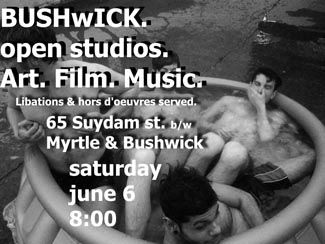
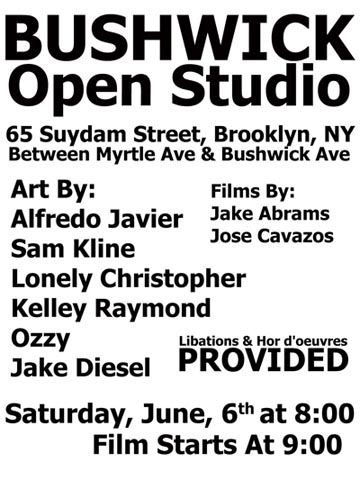
It'll be fun.
It'll be fun.
Subscribe to:
Posts (Atom)