A Statement by Lonely Christopher
For those of you unfamiliar with Dan Savage’s It Gets Better Project congratulations for being so sheltered from all media, but it’s a YouTube video campaign designed as a reaction to the recent publicity over the bullying-related suicide deaths of gay teenagers across the United States. The idea being that, upon hearing stories of tormented LGBT youth who killed themselves out of despair developed through environments of homophobia, abuse, and anti-gay hostility, writer Dan Savage wished he could speak to the teenaged queer community to try and convince troubled youth that middle and high school is torturous, but life gets a lot better and is therefore worth sticking around for. Then he realized that he needn’t wait around for invitations to address this demographic, as YouTube offered him a platform to forgo traditional venues and speak to them directly. The It Gets Better Project began with a great video by Dan Savage and his husband Terry (watch it here) and then opened up the floor for other video contributions. Since then, hundreds of videos have been posted, including a humorous one by actor Jeffrey Self, a very moving one by a councilman in Fort Worth, and many others by regular folk and celebrities alike. While the furious stream of videos tends to become repetitious (the main message being “Don’t kill yourself, wait it out, because it gets so much better”), I feel the project is complicated and tremendously justified. Early on, I decided to create my own contribution for It Gets Better. After drafting a statement and filming it, though, I declined to submit it for several reasons. The project became a cause célèbre overnight and I felt my slightly academic tone was incongruous with the accessibility of the main and, considering the wealth of videos from everyday individuals as well as the slightly condescending ones from famous media figures, both gay and straight, the anti-suicidal musings of a frequently suicidal experimental poet named Lonely Christopher could be both inconsequential and confusing.
First of all, the idea of some weirdo calling himself Lonely Christopher trying to convince queer youth that one day they will not feel so alone is problematic. I felt like I had to address this situation before reaching the fundamental point of my statement, which resulted in an overlong, self-involved preamble. I explained, don’t worry! it’s only an arty pseudonym, I’m really a friendly, semi-adjusted, and sociable person. Wondering if that was really enough, I then went on to try to posit the concept of “loneliness” as a profound and positive characteristic. I attempted this by citing my favorite poem by Emily Dickinson (you can tell how the video is already derailing here). Here is the poem:
There is another Loneliness
That many die without –
Not want of friend occasions it or circumstance of Lot
But nature, sometimes, sometimes thought
And whoso it befall
Is richer than could be revealed
By mortal numeral -
I then attempted to pose this heightened concept of loneliness as a metaphor for queerness, in such a way that a traditionally negatively perceived disposition could be viewed as a liberatory, ultimately subversive, benefit. Like loneliness, queerness is also often viewed in an unfavorable, unhelpful way. But, as Dickinson proves in her poem on loneliness, there is also no singular definition for queerness, what it means to be gay, or whatever word one uses to identify as LGBT. That suggests that one can push past the stereotypes and cultural restrictions around being gay and understand queerness as a special opportunity --- a gift, even, that not everybody has, through which one can really actualize one’s self in a tremendous way. I ended this overwrought point with the only line in the statement I really like: “I guess this is an overly complicated way of saying that I think being queer is basically a super power.”
After that regrettable introduction, which was unnecessary and haughty enough to discourage me from posting the video, I got around to my main purpose (and drew my point out in such a way that my video would have been significantly longer than most offerings available through the project). So that my misguided efforts do not go completely to waste, I here offer the entirety of the rest of my statement (addressed directly to the hypothetical youth watching the video):
You have to celebrate yourself as a queer individual. I know that it’s hard --- and it doesn’t automatically entail coming out to your friends or school or parents, but what I really mean is that you not only have to accept yourself in your own mind, but you have to allow yourself to understand all the ways that you are valuable, unique, and gifted --- and how being queer plays into your perception of self and the world around you. Again, that’s an incredibly hard task. I know I didn’t understand how to view my sexuality in a wholly positive light for many years after I discovered I was queer. That was when I was maybe thirteen, if you can believe it. Many other LGBT people say that they knew at a much earlier age, but I don’t think I was situated in a cultural climate where I was able to understand that about myself preternaturally. It really took until puberty, when I began developing sexual attractions to boys instead of girls, when the possibility dawned on me. And when it did, it was very bad news --- a real private struggle that I was completely alone in and lacked the critical faculties to negotiate. Basically, when these attractions came to my attention, I thought, “Oh no! Please, no! Not another problem I have to deal with!” And this particular problem really did feel like the biggest one in the world --- and one I was experiencing in complete isolation at first.
When I was growing up, “the gays” were only discussed in what was perceived to be a negative context such as AIDS. Being gay was construed as such an unspeakable fault, it seemed almost like anybody so much as talking about it was under suspicion for being a sexual deviant. Sometimes it seems so easy to understand how silly and thoughtless this cultural taboo placed around homosexuality really is, and how insubstantial and indefensible. But that didn’t help me much in school. I was so afraid of being abnormal I really didn’t come out to anybody throughout middle school and high school. It was just inconceivable that something like that, an out gay kid, could actually exist and be in any way accepted or live a normal life. There was a definite environment of homophobia, perpetrated by the students and enforced by the adults, which kept all the queer kids at school very, very quiet about it. At the time, I had male friends who were very worried that I wasn’t taking the same interest in girls as they were. So they set me up with a string off blundering homecoming and prom dates, girlfriends who lasted about a week and couldn’t understand why I wasn’t interested in making out, all of that. And, of course, I had to suffer, day in and day out, hearing almost everybody my age using the word “gay” in a derogatory way, “That’s so gay,” accusing each other of being sissies or fags when they were acting stupid, and all the rest. And whenever I was suspected of being one of those unspeakables, a fag, there was verbal abuse and casual bullying involved.
It was just not a pleasant environment for me to grow up in. I hated school so much. And, you know, when I was a junior, at sixteen, I did try to kill myself. In many ways, first of all, not feeling able to be honest with my parents about who I knew I was, but also, the climate of abuse and mental torture which I experienced, and which I know is prevalent for many others even now, in many ways these were the major contributing factors to my decision to try and prematurely end my life. Fortunately, my attempt was nonfatal --- I was discovered and hospitalized. Being in the hospital, personally, didn’t help me, because even in that drastic situation I was not able to be honest with the doctors and with my family about my sexuality. So that wasn’t really addressed, but I survived, and went back to school --- and somehow I just got through it. And now, of course, it is very obvious that the idea of ending my life was the absolute wrong way to handle that situation. I know that now because, as they say, it gets better.
One of the ways I got through it, I think, was with the Internet. This was a new instrument that just a few years before wasn’t really around. But since it was there, and I had access to it, I was able to discover whole worlds that existed outside of my drab small-town nowhere life --- worlds that were so much more vibrant, cultured, exciting, sexy, and filled with opportunity. I realize that the Internet is and always was a platform for hate and cyber-bullying, which is a problem it seems many teenagers deal with today, but it’s just as much, and I’m sure more, of a positive resource for intelligence, for learning, for communication. Online, I was able to connect with other queer kids my age, far away but in the same situation as I was in, and we were able to form a sort of way of supporting each other from a distance. Also I was afforded access, through the Internet, to forms of culture and troves of information that I would have not otherwise received. If you are watching this video right now, that means that you are utilizing the Internet as a tool to learn about what exists outside of your personal experience. And that’s fabulous.
With the Internet, and reading a lot, and watching lots of movies, and coming into contact with gay culture whenever I could, whether that meant watching Queer as Folk late at night with the volume turned down low so my parents wouldn’t hear or renting John Waters movies from Blockbuster, I gained a lot of perspective and realized that my world, the one I felt stuck in, was not the end of the world. So while my experience with boys was rather limited as a teenager --- and when I did have brief encounters with boys, usually boys from a few towns over, we had to sneak away to the isolated train tracks to even hold hands or briefly kiss --- while I didn’t have much in the way of boyfriends at that age, I did eventually grow comfortable with being more of myself more openly, and expressing myself publically. And although that still did not mean coming out to more than a few very close and understanding female friends --- it meant that I learned how to care less about how the bullies and dullards around me thought of what I did and how I looked or acted. So, with varying degrees of success, I tried to keep afloat during an extended period of depression, self-hatred, confusion, guilt --- all of which contributed to frequent absenteeism in school, plus alcohol and drug abuse --- and then, one day, it was all over.
I left town, went to college in Brooklyn, and never really looked back. And of course I’ve continued to have bad periods, and I make mistakes all the time, but… really, really… the struggle was worth it and the struggle was an education… and, very quickly after I left high school I was prepared to live out of the closest, even though it took me four more years to tell my family, I never again had to lie to my friends about who I was. Because I went to college, I went to art school, I went to the city, and found it very liberating, and found it a place where my queerness was a benefit rather than a deficit, and all sorts of wonderful things happened. I met so many fantastic friends, both queer and straight, who are very supportive, I read a lot of queer theory and became very interested in gay rights activism, I even met my beautiful boyfriend Ryan when we were both featured in a queer poetry reading --- and never again did I have to worry about those things that tormented me when I was younger on the overwhelming level which they were occurring at the time. The first time I held hands with another boy, in the city, and walked down the street without anybody batting an eye, let alone yelling “fag” at us --- it was a revelation. It gets better, seriously, and you’re going to see that so soon.
In conclusion, I want to return to the Dickinson poem, a little bit. Because there is another queerness that many die without. But not you. You have it. If you take anything from this statement, I hope it’s that being queer is whatever you can possibly define it as --- you. Nobody else has the right to define what your sexuality means to you, and the role it plays in your life. And nobody has the right to make you feel terrible about being LGBT. The reality is that we live in a heteronormative society, and that kind of violence and discouragement is still widely tolerated, and you are going to experience discrimination --- but we all face those challenges, we all have our stories, and when we’re determined to stick it out, to refuse to be beaten down by anti-gay abuse, we win. We allow ourselves to live, and to love, and to grow, and that makes us unfathomably lucky. And, you know, I think kids that are fifteen, sixteen, going to school right now --- you are the kids that are going to change the world. So much has happened for gay rights since I was that age --- just that it has become a topic of consistent national debate seems like a miracle to me (despite the vitriol over the issue that comes from certain, ignorant groups of people). So, please, think big, continue, and don’t let your present circumstances cloud your vision of the future.
***
That is the end of my statement. Reading it over again, I feel slightly sorry I wasn’t able to figure out how to reformat it to fit the general structure of the project, but I don’t think its absence on YouTube is a terrible detriment, especially considering all the great videos available on the It Gets Better channel. I recently visited my family, in Western New York, and regrettably dragged some of my old notebooks out of storage in the backyard shed. Reading my journals and letters from high school for the first time since I wrote them, I was struck by how absolutely miserable I felt. One friend with whom I corresponded at the time described my lengthy and tortured letters as a model in suicidal ideation. And, at the time, I absolutely lacked any foresight whatever, beyond the intense desire to leave my hometown surroundings as soon as humanly possible, so whatever happened in school, with being ostracized and mocked, and with my non-comprehending family, it all felt completely inescapable. But, of course, it wasn’t; that is the primary message the It Gets Better Project is delivering to our nation’s LGBT youth. And that is entirely admirable.
Wednesday, October 13, 2010

Monday, October 11, 2010
River
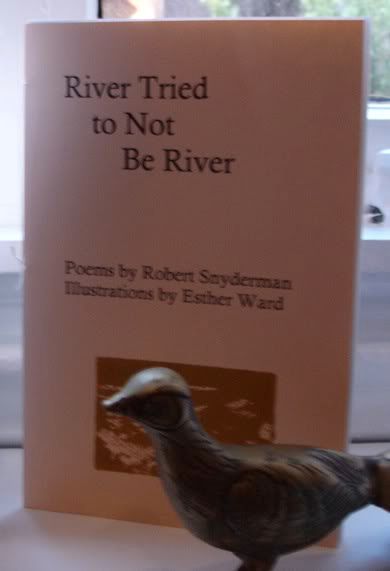
The Corresponding Society is very excited that Splitleaves Press, a chapbook publisher based in Philadelphia, has just released a new poem cycle by Robert Snyderman with illustrations by Esther Ward: River Tried to Not Be River.
Click here to learn more about it!
River Tried to Not be River is a study in contradictions. Graceful and elegant, yet one cannot help but feel an undercurrent of violence and aggression subsumed beneath the surface. Robert Snyderman’s poems can alternately feel like sketches or stories. Either way, one can’t help but relish his turns-of-phrase. Esther Ward’s enigmatic, black and white illustrations could easily stand on their own. Here, as a work of ekphrasis, they only perpetuate River‘s dichotomy.
Saturday, October 2, 2010
Proust/Lasky
Okay guys, the Proust Questionaire is back in business (again). This time we are very pleased to feature super-awesome-uber-poet Dorothea Lasky. If you haven’t heard of Lasky, you need to go read her books (Awe and Black Life) right now. But, most likely, you know very well of her and you love her. The Corresponding Society loves her too. For the curious, blog editor Lonely Christopher reviews Lasky’s latest book, Black Life, here. Now, let’s get to it!
A Brief Introduction to Dorothea Lasky
Dorothea Lasky is an American poet. She was born in St. Louis, Missouri on March 27, 1978. Lasky earned her BA in Classics and Psychology from Washington University in St. Louis. She earned her MFA in Poetry from the University of Massachusetts Amherst's MFA Program for Poets & Writers, and her Ed.M. in Arts & Education from Harvard University. (From Wikipedia.)
Dorothea Lasky Answers the Proust Questionnaire
Your favorite virtue.
Kindness
Your favorite qualities in a man.
Humor
Your favorite qualities in a woman.
Humor
Your chief characteristic.
A changing center
What you appreciate the most in your friends.
Loyalty
Your main fault.
I always want to make everyone happy.
Your favorite occupation.
Teacher
Your idea of happiness.
Freedom
Your idea of misery.
Being constrained
If not yourself, who would you be?
A wolf
Where would you like to live?
Ideally, I would like a house in every town.
Your favorite prose authors.
Lydia Davis, Cicero, Flaubert, Yasunari Kawabata, Eileen Myles, Ivan Turgenev, Flannery O’Connor, Ernest Hemingway, Gertrude Stein
Your favorite poets.
Sylvia Plath and Catullus
Your favorite heroes in fiction.
Ivan Denisovich
Your favorite heroines in fiction.
Madame Bovary
Your favorite painters and composers.
Painters: Arshile Gorky, Paul Gauguin, Edouard Manet, Oskar Kokoschka, William Blake
Composers: Timbaland, Virgil Thomson, Handel, Bach, Stevie Nicks, Brian Wilson, Tom Petty
Your heroes in “real life.”
My father and Martin Luther King, Jr.
What characters in history do you most dislike?
Hitler
Your favorite names.
Violet, Roz, and Buzz
What do you hate the most?
Injustice
What military event do you admire the most?
The founding of Rome
What reform do you admire the most?
Dorothea Dix’s reform work in improving treatment for the mentally ill.
The natural talent you’d like to be gifted with.
Mathematical genius
How do you wish to die?
In my sleep
What is your present state of mind?
Clear
For what fault do you have the most toleration?
Tardiness
Your favorite motto.
Stay loose.
Interestingly enough, Lasky seems to be the only of our participants so far who has previously answered the Proust Questionnaire. Here is a beautiful video she brought to our attention of her answering the questions the first time around:
A Brief Introduction to Dorothea Lasky
Dorothea Lasky is an American poet. She was born in St. Louis, Missouri on March 27, 1978. Lasky earned her BA in Classics and Psychology from Washington University in St. Louis. She earned her MFA in Poetry from the University of Massachusetts Amherst's MFA Program for Poets & Writers, and her Ed.M. in Arts & Education from Harvard University. (From Wikipedia.)
Dorothea Lasky Answers the Proust Questionnaire
Your favorite virtue.
Kindness
Your favorite qualities in a man.
Humor
Your favorite qualities in a woman.
Humor
Your chief characteristic.
A changing center
What you appreciate the most in your friends.
Loyalty
Your main fault.
I always want to make everyone happy.
Your favorite occupation.
Teacher
Your idea of happiness.
Freedom
Your idea of misery.
Being constrained
If not yourself, who would you be?
A wolf
Where would you like to live?
Ideally, I would like a house in every town.
Your favorite prose authors.
Lydia Davis, Cicero, Flaubert, Yasunari Kawabata, Eileen Myles, Ivan Turgenev, Flannery O’Connor, Ernest Hemingway, Gertrude Stein
Your favorite poets.
Sylvia Plath and Catullus
Your favorite heroes in fiction.
Ivan Denisovich
Your favorite heroines in fiction.
Madame Bovary
Your favorite painters and composers.
Painters: Arshile Gorky, Paul Gauguin, Edouard Manet, Oskar Kokoschka, William Blake
Composers: Timbaland, Virgil Thomson, Handel, Bach, Stevie Nicks, Brian Wilson, Tom Petty
Your heroes in “real life.”
My father and Martin Luther King, Jr.
What characters in history do you most dislike?
Hitler
Your favorite names.
Violet, Roz, and Buzz
What do you hate the most?
Injustice
What military event do you admire the most?
The founding of Rome
What reform do you admire the most?
Dorothea Dix’s reform work in improving treatment for the mentally ill.
The natural talent you’d like to be gifted with.
Mathematical genius
How do you wish to die?
In my sleep
What is your present state of mind?
Clear
For what fault do you have the most toleration?
Tardiness
Your favorite motto.
Stay loose.
Interestingly enough, Lasky seems to be the only of our participants so far who has previously answered the Proust Questionnaire. Here is a beautiful video she brought to our attention of her answering the questions the first time around:
Wednesday, September 15, 2010
Mischief + Mayhem
Here is a press release and launch party invite from our friends over at Mischief + Mayhem:
New Writers Collective Joins Forces With OR Books
in an Alternative Approach to Publishing
Novelist and critic Dale Peck, blogger Choire Sicha among those collaborating with OR to launch Mischief + Mayhem imprint
Meghan Daum, Nick Flynn, A.M. Homes, and Joseph O’Neill are among the noted writers joining forces on the evening of Sept. 28, 2010 to launch Mischief + Mayhem, a new imprint affiliated with OR Books, the alternative publisher that made headlines and bestseller lists in 2009 with Going Rouge, its controversial anti–Sarah Palin polemic. The event will feature burlesque dancers, live music, a raffle, and an interactive literary game involving more than thirty writers from around the world.
Mischief + Mayhem’s noteworthy founders are Lisa Dierbeck (One Pill Makes You Smaller), Joshua Furst (Short People, The Sabotage Café), DW Gibson, executive director of Ledig House and Sangam House, Dale Peck (Martin and John, What We Lost, Hatchet Jobs), and Choire Sicha, co-owner of The Awl, whose first book of nonfiction is forthcoming from HarperCollins. Utilizing OR Books’ groundbreaking publishing methods, the collective intends to promulgate fiction that is formally inventive, socially irresponsible, and sometimes just plain reckless without having to worry about pleasing conservative editorial boards or corporate bookstore executives. It will also help writers earn a living wage without compromising their radical aesthetics.
“Mainstream publishers are more risk-averse than ever,” said Peck. “Instead of courting a mass audience with formulaic, commercial books, Mischief + Mayhem will look for weird, wild voices and writers of idiosyncratic, even skewed, vision. We don’t just want the new, we want the strange, the unsettling, the scary.”
The imprint’s lead title, Dierbeck’s The Autobiography of Jenny X, forthcoming in November 2010, has already been hailed as “Fast, funny, and twisted,” by Netherland author Joseph O’Neill, while Pagan Kennedy, author of The First Man-Made Man, dubbed it “Baader Meinhof meets Marvel comics.” Dierbeck’s novel will be followed by DW Gibson’s debut, An All-American Field Guide to the Outside World. Other writers on the M+M docket include Calvin Baker (Once Two Heroes, Dominion), Helen DeWitt (The Last Samurai), and Mike Heppner (The Egg Code, Pike’s Folly).
Like OR Books, Mischief + Mayhem’s titles will be produced only in electronic or print-on-demand editions, and will be available, initially at least, exclusively for purchase online from the publisher. This arrangement avoids the enormous waste of the current publishing system, which ships books to stores, fails to promote them, and then sees many of them returned, unsold, to the publisher.
The company’s publishing mission is supported by Wild Rag, a blog and webzine whose regular contributors include such well-respected writers as New Yorker editor Ben Greenman, journalist and editor Zia Jaffrey, and New York Times art critic Martha Schwendener, each of whom will offer a challenging, rambunctious perspective on things literary, cultural, and political. Additionally, the company plans to host readings, performances and other social gatherings in order to build a literary community in the real world as well as online.
“Reviews for Sale”
Launch Party Sept. 28
To coincide with the launch of the imprint, Mischief + Mayhem invites the public to join them for a celebration featuring tequila, burlesque, graffiti, rock and roll, and, of course, literature on Sept. 28, 2010 from 6:30 – 8:30 pm at Room Service, at 35 E. 21st St., in New York City. The evening’s centerpiece will be a massive literary exquisite corpse, a collectively written story that dramatizes what can happen when writers work together for a common goal. Between thirty and forty writers from around the globe are expected to join in; as of this writing, participants include Taylor Antrim, Rebecca Brown, T Cooper, Meghan Daum, Helen DeWitt, Tishani Doshi, Nora Eisenberg, Ben Greenman, Daniel Handler, Mike Heppner, Kaylie Jones, Jim Lewis, Lonely Christopher, Lauren Mechling, Sigrid Nuñez, Joseph O’Neill, Donald Ray Pollock, Irina Reyn, Julian Rubinstein, Ben Schrank, Owen Sheers, Jim Shepard, Karen Shepard, and Amy Sohn.
Also on the agenda: a burlesque dancer with a dress made from the pages of a book, a live band (TBD), and the first-ever Mischief + Mayhem Read-In, which champions reading in any environment, no matter how loud or drunken. Speaking of which: guests are invited to sample the Mischief + Mayhem cocktail, a shot of tequila with a whole habañero pepper dropped in. Don’t say you weren’t warned!
The evening’s final lure is a raffle whose prizes include a graffiti kit (stencils, spraypaint, and a wild rag to conceal your identity), a half-case of wine from Tinto Fino, a free dinner at Tipsy Parson, and a photograph by acclaimed artist Matthew Pillsbury. In keeping with the collective’s mischievous spirit, the grand prize is a review-to-order by Dale Peck---good or bad, of (virtually) any author the winner chooses. Who knows, perhaps the Hatchet Man will end up slamming himself?


“No Book Printed Until It's Sold”
A Bold New Way to Publish Books
“No book printed until it's sold” is the unofficial motto of OR Books, which will publish the Mischief + Mayhem list. A genuinely new type of publishing company, OR sells direct to the customer in print-on-demand formats and e-books. There is no warehouse, no returns, and no waste. The savings this makes possible enables unprecedented levels of marketing, both online and through regular channels. Once momentum has been created behind a title OR looks for rights deals with conventional publishing partners to make the book available in bookstores.
OR was created by John Oakes, who co-founded the independent publisher Four Walls Eight Windows and has published Andrei Codrescu, Sue Coe, R. Crumb, Abbie Hoffman, Gordon Lish, Harvey Pekar, John Waters and Edmund White, and serves on the board of PEN America; and Colin Robinson, the former publisher of New Press and Verso, who, among many other accomplishments, made an upscale edition of The Communist Manifesto into a bestseller. Writers Robinson has published include Tariq Ali, Noam Chomsky, Alexander Cockburn, Mike Davis, Norman Finkelstein, Lewis Lapham, Rigoberta Menchu, Sheila Rowbotham and Jann Wenner.
“We’re excited to be working with Mischief + Mayhem,” said Robinson. “Their zest for adventurous, intelligent writing and enthusiasm for seeking new ways of reaching readers chime very closely with our own approach.”
New Writers Collective Joins Forces With OR Books
in an Alternative Approach to Publishing
Novelist and critic Dale Peck, blogger Choire Sicha among those collaborating with OR to launch Mischief + Mayhem imprint
Meghan Daum, Nick Flynn, A.M. Homes, and Joseph O’Neill are among the noted writers joining forces on the evening of Sept. 28, 2010 to launch Mischief + Mayhem, a new imprint affiliated with OR Books, the alternative publisher that made headlines and bestseller lists in 2009 with Going Rouge, its controversial anti–Sarah Palin polemic. The event will feature burlesque dancers, live music, a raffle, and an interactive literary game involving more than thirty writers from around the world.
Mischief + Mayhem’s noteworthy founders are Lisa Dierbeck (One Pill Makes You Smaller), Joshua Furst (Short People, The Sabotage Café), DW Gibson, executive director of Ledig House and Sangam House, Dale Peck (Martin and John, What We Lost, Hatchet Jobs), and Choire Sicha, co-owner of The Awl, whose first book of nonfiction is forthcoming from HarperCollins. Utilizing OR Books’ groundbreaking publishing methods, the collective intends to promulgate fiction that is formally inventive, socially irresponsible, and sometimes just plain reckless without having to worry about pleasing conservative editorial boards or corporate bookstore executives. It will also help writers earn a living wage without compromising their radical aesthetics.
“Mainstream publishers are more risk-averse than ever,” said Peck. “Instead of courting a mass audience with formulaic, commercial books, Mischief + Mayhem will look for weird, wild voices and writers of idiosyncratic, even skewed, vision. We don’t just want the new, we want the strange, the unsettling, the scary.”
The imprint’s lead title, Dierbeck’s The Autobiography of Jenny X, forthcoming in November 2010, has already been hailed as “Fast, funny, and twisted,” by Netherland author Joseph O’Neill, while Pagan Kennedy, author of The First Man-Made Man, dubbed it “Baader Meinhof meets Marvel comics.” Dierbeck’s novel will be followed by DW Gibson’s debut, An All-American Field Guide to the Outside World. Other writers on the M+M docket include Calvin Baker (Once Two Heroes, Dominion), Helen DeWitt (The Last Samurai), and Mike Heppner (The Egg Code, Pike’s Folly).
Like OR Books, Mischief + Mayhem’s titles will be produced only in electronic or print-on-demand editions, and will be available, initially at least, exclusively for purchase online from the publisher. This arrangement avoids the enormous waste of the current publishing system, which ships books to stores, fails to promote them, and then sees many of them returned, unsold, to the publisher.
The company’s publishing mission is supported by Wild Rag, a blog and webzine whose regular contributors include such well-respected writers as New Yorker editor Ben Greenman, journalist and editor Zia Jaffrey, and New York Times art critic Martha Schwendener, each of whom will offer a challenging, rambunctious perspective on things literary, cultural, and political. Additionally, the company plans to host readings, performances and other social gatherings in order to build a literary community in the real world as well as online.
“Reviews for Sale”
Launch Party Sept. 28
To coincide with the launch of the imprint, Mischief + Mayhem invites the public to join them for a celebration featuring tequila, burlesque, graffiti, rock and roll, and, of course, literature on Sept. 28, 2010 from 6:30 – 8:30 pm at Room Service, at 35 E. 21st St., in New York City. The evening’s centerpiece will be a massive literary exquisite corpse, a collectively written story that dramatizes what can happen when writers work together for a common goal. Between thirty and forty writers from around the globe are expected to join in; as of this writing, participants include Taylor Antrim, Rebecca Brown, T Cooper, Meghan Daum, Helen DeWitt, Tishani Doshi, Nora Eisenberg, Ben Greenman, Daniel Handler, Mike Heppner, Kaylie Jones, Jim Lewis, Lonely Christopher, Lauren Mechling, Sigrid Nuñez, Joseph O’Neill, Donald Ray Pollock, Irina Reyn, Julian Rubinstein, Ben Schrank, Owen Sheers, Jim Shepard, Karen Shepard, and Amy Sohn.
Also on the agenda: a burlesque dancer with a dress made from the pages of a book, a live band (TBD), and the first-ever Mischief + Mayhem Read-In, which champions reading in any environment, no matter how loud or drunken. Speaking of which: guests are invited to sample the Mischief + Mayhem cocktail, a shot of tequila with a whole habañero pepper dropped in. Don’t say you weren’t warned!
The evening’s final lure is a raffle whose prizes include a graffiti kit (stencils, spraypaint, and a wild rag to conceal your identity), a half-case of wine from Tinto Fino, a free dinner at Tipsy Parson, and a photograph by acclaimed artist Matthew Pillsbury. In keeping with the collective’s mischievous spirit, the grand prize is a review-to-order by Dale Peck---good or bad, of (virtually) any author the winner chooses. Who knows, perhaps the Hatchet Man will end up slamming himself?
“No Book Printed Until It's Sold”
A Bold New Way to Publish Books
“No book printed until it's sold” is the unofficial motto of OR Books, which will publish the Mischief + Mayhem list. A genuinely new type of publishing company, OR sells direct to the customer in print-on-demand formats and e-books. There is no warehouse, no returns, and no waste. The savings this makes possible enables unprecedented levels of marketing, both online and through regular channels. Once momentum has been created behind a title OR looks for rights deals with conventional publishing partners to make the book available in bookstores.
OR was created by John Oakes, who co-founded the independent publisher Four Walls Eight Windows and has published Andrei Codrescu, Sue Coe, R. Crumb, Abbie Hoffman, Gordon Lish, Harvey Pekar, John Waters and Edmund White, and serves on the board of PEN America; and Colin Robinson, the former publisher of New Press and Verso, who, among many other accomplishments, made an upscale edition of The Communist Manifesto into a bestseller. Writers Robinson has published include Tariq Ali, Noam Chomsky, Alexander Cockburn, Mike Davis, Norman Finkelstein, Lewis Lapham, Rigoberta Menchu, Sheila Rowbotham and Jann Wenner.
“We’re excited to be working with Mischief + Mayhem,” said Robinson. “Their zest for adventurous, intelligent writing and enthusiasm for seeking new ways of reaching readers chime very closely with our own approach.”
Monday, September 13, 2010
The Day After I Answered Them
Previously, in June, Lonely Christopher posted an I Remember exercise, inspired by Joe Brainard; coincidentally, fellow Correspondence editor Robert Snyderman was asked to complete a similar exercise in a pedagogy class he is taking this fall at Brown. Please find his piece below, for your perusal.
I Remember
by Robert Snyderman
I remember a paradise of yarrow in each eye
I remember not praying in Brooklyn with my head in the ground asking prayer what
prayer is and thinking to question prayer is prayer
I remember the civil war of sleep
I remember being ashamed of my unruly curly hair in fourth grade
I remember reading Carl Sandburg to a table of friends the night before I left Brooklyn
for Vermont
I remember reciting nothing
I remember wanting to remember the horizon in northern Vermont as a long white force
below the night field falling like a calf slipping bathed in black flies and cow tongue
I remember "There is no paradisal dream. Its hardship is its reality"
I remember practicing my eternal intentions
I remember losing. The earth of my knees. Ash is still
I remember my dreams and my brother's dreams
I remember the uprooted and the falling, where men seemed wooden because I had not
been wooden. Ash is still
I remember the wolf that rested upon the back of my neck in California beside Lake
Tahoe
I remember looking down and speaking. The rules harvested me and so I disobeyed the
illusion of my father. And my brother ran right. My other brother ran left
I remember needing to speak with my brother in the morning after waking. I dream
violence, and he is consistent and I sweat our mother's hands, and here, there is an
illusion
I remember praising someone in a formless state
I remember losing strength like a birth
I remember leaping off a bridge after her and after her and after her
I remember the Tower of Babel. Surrender the spherical weather of your sexual beliefs
and improvisational stillness. Sell your books. Maintain the faith of goats
I remember constructing ideals in states of mountainous illusion, though gaining strength
and attention and wingspan, though losing the spade of body mass, though puncturing
though piercing human longevity, hardening longevity
I remember desiring less possessions
I remember desiring more possessions
I remember not to trust myself all day, all night
I remember making so as to ward myself off
I remember my brothers asking me if I believed in G-d. I traveled to see them the day
after the day after I answered them
I Remember
by Robert Snyderman
I remember a paradise of yarrow in each eye
I remember not praying in Brooklyn with my head in the ground asking prayer what
prayer is and thinking to question prayer is prayer
I remember the civil war of sleep
I remember being ashamed of my unruly curly hair in fourth grade
I remember reading Carl Sandburg to a table of friends the night before I left Brooklyn
for Vermont
I remember reciting nothing
I remember wanting to remember the horizon in northern Vermont as a long white force
below the night field falling like a calf slipping bathed in black flies and cow tongue
I remember "There is no paradisal dream. Its hardship is its reality"
I remember practicing my eternal intentions
I remember losing. The earth of my knees. Ash is still
I remember my dreams and my brother's dreams
I remember the uprooted and the falling, where men seemed wooden because I had not
been wooden. Ash is still
I remember the wolf that rested upon the back of my neck in California beside Lake
Tahoe
I remember looking down and speaking. The rules harvested me and so I disobeyed the
illusion of my father. And my brother ran right. My other brother ran left
I remember needing to speak with my brother in the morning after waking. I dream
violence, and he is consistent and I sweat our mother's hands, and here, there is an
illusion
I remember praising someone in a formless state
I remember losing strength like a birth
I remember leaping off a bridge after her and after her and after her
I remember the Tower of Babel. Surrender the spherical weather of your sexual beliefs
and improvisational stillness. Sell your books. Maintain the faith of goats
I remember constructing ideals in states of mountainous illusion, though gaining strength
and attention and wingspan, though losing the spade of body mass, though puncturing
though piercing human longevity, hardening longevity
I remember desiring less possessions
I remember desiring more possessions
I remember not to trust myself all day, all night
I remember making so as to ward myself off
I remember my brothers asking me if I believed in G-d. I traveled to see them the day
after the day after I answered them
Saturday, September 4, 2010
Super Reading
From our friends over at SUPERMACINE:
SUPERMACHINE ISSUE #2 LAUNCH PARTY
7:30pm, Sept. 10, 2010
The Schoolhouse
330 Ellery St
Brooklyn, NY 11206
Readings! Music! Your Autumn Crush!
with:
Macgregor Card
Chris Cheney
Lonely Christopher
Corina Copp
Jon Cotner
Joanna Penn Cooper
Anne Cecelia Holmes
Lauren Ireland
Simone Kearney
Dorothea Lasky
Paul Legault
Emily Pettit
Christie Ann Reynolds
Matvei Yankelevich
Matthew Yeager
Are You Fucking Kidding Me ?!
SUPERMACHINE ISSUE #2 LAUNCH PARTY
7:30pm, Sept. 10, 2010
The Schoolhouse
330 Ellery St
Brooklyn, NY 11206
Readings! Music! Your Autumn Crush!
with:
Macgregor Card
Chris Cheney
Lonely Christopher
Corina Copp
Jon Cotner
Joanna Penn Cooper
Anne Cecelia Holmes
Lauren Ireland
Simone Kearney
Dorothea Lasky
Paul Legault
Emily Pettit
Christie Ann Reynolds
Matvei Yankelevich
Matthew Yeager
Are You Fucking Kidding Me ?!
Sunday, August 22, 2010
The Tipsy Critics: Hamlet (Part 2)
The Corresponding Society is drunk to present the second part of the first installment of our new video feature The Tipsy Critics. Recently, writers Mae Saslaw and Lonely Christopher sat down to discuss the play Hamlet by William Shakespeare over drinks. In part one, which you can watch here, an attempt to summarize the action of the play led to a discussion mainly about ghosts and the Twilight movies; in part two it is concluded that, contrary to popular belief, Shakespeare wasn’t a black woman (but he was a terrifically bad writer, who knew?). See for yourself:
Tipsy Critics Present Hamlet, Part II from Mae Saslaw on Vimeo.
Subscribe to:
Posts (Atom)