Christopher Sweeney, the reclusive director of The Corresponding Society (and editor-in-chief of the journal), was recently caught on tape in a conversation, with this blog’s web editor, which addressed specific issues related to our press and journal as well as broader considerations of contemporary poetics and the processes of younger writers. Characteristically he wasn’t wearing a shirt.
Lonely Christopher: How would you define The Corresponding Society?
Sweeney: It’s a project that was conceived in, probably, November 2007 amongst a group of writers⎯six of us, I would say, who’ve been living in Brooklyn now for a long time. The group itself began before that with a reading series we started called The Gates Salon (which is basically an open mic for friends, associates, and really anyone who wants to come). I think, to some extent at least, it’s an attempt to begin more concretely developing a community of writers⎯not necessarily along any specific aesthetic lines or particular approaches to craft, but a young group that’s Brooklyn-based (although we don’t exclude people from other locations).
LC: What are the purposes or functions of Correspondence?
Sw: I think the hope is probably, on one hand, that it’s intended to be an outlet for publication for young writers (that’s how it is mostly right now, but we also feature older, more established writers) that we know and are excited about; the second thing is to begin to encourage a journal that is really focused on an advanced development of craft and formal ability.
LC: What makes our establishment of a group (a press) relevant or appropriate considering that the ideologies and formal directions of all the members are so dissimilar?
Sw: I think that it’s obvious looking at The New American Poetry anthology, which published a lot of work at the time focusing on many different journals, and throughout much of the last half century’s work, that oftentimes literary groups don’t form along specific aesthetic lines; often it’s just a lot of talented individuals that grow out of an engagement that does not necessarily translate into congruent ideas. I think it’s often the conflict of ideas, opinions, and styles that leads to better work and better engagement than a sort of unanimous consent or congruence.
LC: How do you feel literary journals function in the landscape of contemporary writing as you understand it and, considering possible paradigmatic shifts that have occurred over the past century (especially re the Internet’s influence), do they function as vitally as possible in our contemporary context?
Sw: I don’t know for sure; I’ve actually had trouble with this question for other journals⎯and our own. In general my experience with literary journals coming out recently is that it’s been pretty bland. Poetry in general has not excited me much in the last fifteen years of work that I’ve seen. I think most of the time literary journals have no effect or no meaning. It’s difficult to maintain a literary journal for its own sake⎯more or less, anyone publishing in a journal, particularly anyone of note, is also publishing elsewhere; so there’s little to distinguish one journal from another. I think one possible use of a journal, one of the better uses that I can currently think of, is as a formal documentation of a literary community through time. I don’t think there is any journal or that there’s going to be any journal that necessarily stands out. I think, in a lot of ways, that a simple documentation of a group is a worthwhile goal for a journal.
LC: What are your expectations and hopes for The Corresponding Society?
Sw: I certainly would like to continue publishing. Our schedule for the journal right now is biannual; I think the ultimate goal is for it to be quarterly. Also the press wants to begin publishing novels and book-length poems or collections soon. Furthermore, the hope would be to increase circulation.
LC: How would you describe an ideal reader of Correspondence?
Sw: I think in some ways the best readers so far have been the people involved. It’s been rewarding and interesting to hear the responses of contributors. While I know just about every contributor, not all of them know each other; it’s been interesting to introduce writers to each other.
LC: Isn’t that a little hermetic?
Sw: Yeah, certainly. I guess I don’t know what expectations to have for a wider reception of the journal.
LC: How does geography relate to the Corresponding Society⎯that is to say are we mostly localized or do we represent work being produced in various locations and coming together through a medium of communication such as the Internet?
Sw: It’s certainly based in Brooklyn⎯but in the first issue we published work by a handful of people from Connecticut, from Pennsylvania, Michigan, Denver, San Francisco, Scotland, and Paris. In a lot of ways it extends beyond Brooklyn; for some involved we communicate primarily through the Internet and the press. The hope for the future is that it will extend even further.
LC: How do you perceive the state of the arts in Brooklyn (especially concerning the writing community, which is so often marketed as strong and important here)?
Sw: It is often marketed that there are strong writing communities here⎯I personally have no idea what those people are talking about. There certainly are writers in Brooklyn, there are many, but I don’t think many of them are interesting. For me, and there’s certainly something I could seriously be missing, but the two dominant trends that I see from where I stand include a style of work which⎯I know you won’t like this⎯harps on experimentalism and novelty for its own sake (as far as I understand it), and then there’s confessional or memoir-based writing that’s more about telling and sharing personal stories than it is about direct engagement with craft (and I don’t find that interesting either).
LC: How do you see your peers developing as writers in contradistinction to your ideas about writing?
Sw: There are actually few people developing along the same lines as myself. I think Dave Swensen (a contributing editor) is someone often working in a similar vein, but that’s pretty much it. I mean, you are someone whose work is very obviously developing in a different direction than mine⎯it’s work that’s really engaged with innovative formal elements. Chanelle Bergeron (a writer in the first issue) is going in another direction still⎯whereas I often take Pound, Eliot, and Crane as my models I see a lot of cummings in her work. I see a sort of wordplay and imagination that I don’t feel I currently have. Then there are certain writers, Matthew Daniel and Robert Snyderman, who I think are⎯certainly not disengaged, but maybe I don’t even understand fully the formal direction by which they’re approaching their work. Robert’s work is somewhat similar to mine in that he takes dialogues from Persephone, Hades, and Demeter⎯but he’s pushing it in a more experimental direction. I’m not really sure.
LC: As somebody who is deeply invested in the model of high modernism, do you think contemporary poetics are problematic and if so, how⎯and what must young writers do to engage with poetics in a more important/relevant way?
Sw: Well, I have spent a lot of time studying, working, writing through the high modernists. I think I’m trying to begin to step out of that⎯not that it’s gone too far but one poet I’ve been reading a lot of recently is John Berryman, who has traces of high modernism but begins moving it in a much less romantic, much more colloquial direction. I think the fact that I’ve been so obstinate with the high modernists has been a fault in some ways, yet in some ways I do get the impression that a lot of the time young poets are not making the necessary commitment to discovering and studying the poetic tradition that precedes them; they sort of skim through, or skip over entirely, Eliot and Pound simply because at first glance it’s difficult. Often it’s those same writers who don’t do much reading of earlier poets. One person I began reading a lot of in the last year is John Donne. So I think there needs to be a more effective engagement with the historical tradition of poetry, and I think there’s just a fundamental danger with attempting to found your poetics solely on the current decade or two of work. The danger with reading contemporary work is always the fact that it’s easy to get caught up in trends and fads and to not be able to discern what’s enduring about any given poet. Unless you can begin to do that you don’t really even have a grounds on which you can judge contemporary work.
Wednesday, September 17, 2008

Monday, September 15, 2008
Theater on YouTube and in Long Island City
YouTube Follies
Something I forgot to mention was that the Institutionalized Theater, an affiliate with this very press, presented two one-act plays at The Bowery Poetry Club at the end of August. Gay Play, written and directed by this self-same web editor, was unfortunately not recorded for posterity⎯but the other piece, Slump Boat Sway, was filmed on some sort of cheap digital camera and is now available online. The monologue was directed by (presumed Corresponding Society member) A.E. Wilson and features performances by Lonely Christopher and MK Chillemi. Although the image is pixilated to the point of abstraction and the sound quality is so poor it sounds like I have a serious speech impediment, interested parties are yet welcomed to check it out at the following links: Part I, Part II, & Part III. And since I am on the subject of video clips of Institutionalized performances that are available on YouTube, I might as well mention some older material as well. The following clips are from our very first show (which was a scrappy endeavor that ended up the subject of at least one major scandal) that culminated in a cacophonic madhouse of a dramatic event called Morning Morning, conceived by Corresponding Society member and Poem Shop writer Robert Snyderman. You can watch the end here: Part I & Part II. It’s peculiar how much stuff ends up on this YouTube. Somebody even took the time to post a video of me tripping over a difficult poem after somebody set a camera flash off in my face at a Small Anchor Press reading a while back (though I won’t post the link to that out of embarrassment). Of course YouTube is all well and good, but I would recommend UbuWeb, an archive of avant-garde materials managed by Kenneth Goldsmith. PennSound, directed by Charles Bernstein and Al Filreis, is also a tremendously valuable resource.
With Golden Thread on One End

This isn’t really related to matters of the Corresponding Society or its affiliates, but certainly worth mentioning. I am currently working as an Assistant Stage Manager on a play, presented at The Chocolate Factory (it’s in Queens!), titled 1965UU. It’s by Mac Wellman, directed by Steve Mellor, and stars Paul Lazar. The show is basically a monologue; the text is quite dense and linguistically tangled, but it still manages to be playful, marvelously humorous, and ultimately profoundly ruminative. The show is running Thursdays through Saturdays until October 4th⎯go see it. For the occasional reader who (for whatever inexcusable reason) does not live in New York City (it’s okay if you don’t live in Queens, Queens is weird), I wholly recommend picking up a copy of Wellman’s collection The Chronicle of the Madness of Small Worlds (from which 1965UU is adapted). The book is among the few that make me feel a little better about the state of contemporary short fiction (the only other two that occur to me right now are selected bits of Gary Lutz and Girl with Curious Hair by the recently departed David Foster Wallace). Working with the likes of Mac, Steve, and Paul has been a really exciting and beneficial experience for me. Here’s a picture of Paul in costume as the ingenuous Dr. Ravenello:

Something I forgot to mention was that the Institutionalized Theater, an affiliate with this very press, presented two one-act plays at The Bowery Poetry Club at the end of August. Gay Play, written and directed by this self-same web editor, was unfortunately not recorded for posterity⎯but the other piece, Slump Boat Sway, was filmed on some sort of cheap digital camera and is now available online. The monologue was directed by (presumed Corresponding Society member) A.E. Wilson and features performances by Lonely Christopher and MK Chillemi. Although the image is pixilated to the point of abstraction and the sound quality is so poor it sounds like I have a serious speech impediment, interested parties are yet welcomed to check it out at the following links: Part I, Part II, & Part III. And since I am on the subject of video clips of Institutionalized performances that are available on YouTube, I might as well mention some older material as well. The following clips are from our very first show (which was a scrappy endeavor that ended up the subject of at least one major scandal) that culminated in a cacophonic madhouse of a dramatic event called Morning Morning, conceived by Corresponding Society member and Poem Shop writer Robert Snyderman. You can watch the end here: Part I & Part II. It’s peculiar how much stuff ends up on this YouTube. Somebody even took the time to post a video of me tripping over a difficult poem after somebody set a camera flash off in my face at a Small Anchor Press reading a while back (though I won’t post the link to that out of embarrassment). Of course YouTube is all well and good, but I would recommend UbuWeb, an archive of avant-garde materials managed by Kenneth Goldsmith. PennSound, directed by Charles Bernstein and Al Filreis, is also a tremendously valuable resource.
With Golden Thread on One End
This isn’t really related to matters of the Corresponding Society or its affiliates, but certainly worth mentioning. I am currently working as an Assistant Stage Manager on a play, presented at The Chocolate Factory (it’s in Queens!), titled 1965UU. It’s by Mac Wellman, directed by Steve Mellor, and stars Paul Lazar. The show is basically a monologue; the text is quite dense and linguistically tangled, but it still manages to be playful, marvelously humorous, and ultimately profoundly ruminative. The show is running Thursdays through Saturdays until October 4th⎯go see it. For the occasional reader who (for whatever inexcusable reason) does not live in New York City (it’s okay if you don’t live in Queens, Queens is weird), I wholly recommend picking up a copy of Wellman’s collection The Chronicle of the Madness of Small Worlds (from which 1965UU is adapted). The book is among the few that make me feel a little better about the state of contemporary short fiction (the only other two that occur to me right now are selected bits of Gary Lutz and Girl with Curious Hair by the recently departed David Foster Wallace). Working with the likes of Mac, Steve, and Paul has been a really exciting and beneficial experience for me. Here’s a picture of Paul in costume as the ingenuous Dr. Ravenello:
Wednesday, September 3, 2008
Three Articles
1) For those of you patiently waiting to receive your copy of Correspondence No. 1 in the mail, know that you shall presently (or as soon as the Postal Service allows, though I certainly accept the blame for running away from the local post office, clutching a stack of packages, at the slightest line [that being the primary cause for any delay]). We are delighted by your order and pray you enjoy the contents of our inaugural issue. 2) If, dear reader, the above address did not apply to you for the simple reason that you have been dragging your feet (as the expression has it) in the matter of ordering a copy (by emailing us) then please note the following: we are finally nearer to a dwindling supply and anticipate selling out the entire print run before the second issue premieres⎯thus it would be apt for anyone to place his order sooner rather than later if he truly desires to possess a copy. 3) Although! We are pleased to announce that Correspondence No. 1 is now for sale at the Bowery Poetry Club, so if you’re strolling down the Bowery you now have the option to forgo the wait to receive a copy from us by mail. The journal might begin to appear in a few other places and we’ll certainly note it here when that happens. It’s also worth mentioning that the first issue is available through Poem Shop, which can be found sporadically in public parks around Manhattan.
Thursday, August 28, 2008
Hipster Definition
Hipster Week at The Corresponding Society Internet Presence belatedly continues, sort of. Several members of The Corresponding Society have been asked to evaluate contemporary hipster culture for the purpose of better understanding the social phenomenon we are exposed to daily.
On Why There Is No Definition of a Hipster
by Mae Saslaw
There is no static criteria for determining hipsterdom and therefore no established method for distinguishing a hipster. For this reason, an individual's hipster status may be entirely up for debate or interpretation, questionable, or at least shaky. It is easy enough to imagine a hipster denying hipster status⎯and this is common behavior⎯but is it possible to be a non-hipster and self-identify as one? If so much of one's hipster status rests upon one's identification or lack thereof as a hipster, and yet there are no rules governing who is or is not same, is anyone actually a hipster? More importantly, is anyone entering into a discourse regarding hipster status not a hipster? This is the fluid nature of hipsterdom. But why are there no criteria, why is there no litmus test? In any other counter-culture or sub-culture movement of the past thirty years, there have been concrete characteristics of members of the group. For example, the punk movement was clearly marked by dress, music, lifestyle, etc. This has served in the past as a unifying, solidifying necessity for any group: members want to establish their membership and broadcast it in a legible way. Hipsters have avoided hipster solidarity, and I propose two linked reasons: 1) they hate each other because 2) "hipster" has been a pejorative term since its inception. Hipsters typically complain about a lack of authenticity exhibited by other hipsters, and these complaints are misplaced due to a certain phenomenon my peers have described, namely, there is no such thing as an authentic hipster. How does such a "movement" founded on absolutely nothing occur, let alone persist? Given that identifying hipsters is such a slippery slope to begin with, I propose that the very existence of hipsters may be purely linguistic. One can refute or deny his or her hipsterdom, providing evidence such as dress and places of habitation or social activity, but the question will usually remain unanswered. By contrast, punk identity is significantly easier to define, if only because the punk movement produced its own culture. Hipsters produce notions of hipsterdom, but no cultural artifacts to help establish a movement. It is counterintuitive to imagine that mere notions can form identity, and yet they have. Is it not these very notions that are being discussed, and are they not substantive enough to warrant their own discussion? Despite the fact that the word "hipster" exists and has been accepted in common usage, it is barely legible; it reminds me of that historic Supreme Court opinion on pornography: I can't define it, but I know it when I see it.
On Why There Is No Definition of a Hipster
by Mae Saslaw
There is no static criteria for determining hipsterdom and therefore no established method for distinguishing a hipster. For this reason, an individual's hipster status may be entirely up for debate or interpretation, questionable, or at least shaky. It is easy enough to imagine a hipster denying hipster status⎯and this is common behavior⎯but is it possible to be a non-hipster and self-identify as one? If so much of one's hipster status rests upon one's identification or lack thereof as a hipster, and yet there are no rules governing who is or is not same, is anyone actually a hipster? More importantly, is anyone entering into a discourse regarding hipster status not a hipster? This is the fluid nature of hipsterdom. But why are there no criteria, why is there no litmus test? In any other counter-culture or sub-culture movement of the past thirty years, there have been concrete characteristics of members of the group. For example, the punk movement was clearly marked by dress, music, lifestyle, etc. This has served in the past as a unifying, solidifying necessity for any group: members want to establish their membership and broadcast it in a legible way. Hipsters have avoided hipster solidarity, and I propose two linked reasons: 1) they hate each other because 2) "hipster" has been a pejorative term since its inception. Hipsters typically complain about a lack of authenticity exhibited by other hipsters, and these complaints are misplaced due to a certain phenomenon my peers have described, namely, there is no such thing as an authentic hipster. How does such a "movement" founded on absolutely nothing occur, let alone persist? Given that identifying hipsters is such a slippery slope to begin with, I propose that the very existence of hipsters may be purely linguistic. One can refute or deny his or her hipsterdom, providing evidence such as dress and places of habitation or social activity, but the question will usually remain unanswered. By contrast, punk identity is significantly easier to define, if only because the punk movement produced its own culture. Hipsters produce notions of hipsterdom, but no cultural artifacts to help establish a movement. It is counterintuitive to imagine that mere notions can form identity, and yet they have. Is it not these very notions that are being discussed, and are they not substantive enough to warrant their own discussion? Despite the fact that the word "hipster" exists and has been accepted in common usage, it is barely legible; it reminds me of that historic Supreme Court opinion on pornography: I can't define it, but I know it when I see it.
Wednesday, August 13, 2008
The Hipster Function
It’s Hipster Week at The Corresponding Society Internet Presence. Several members of The Corresponding Society have been asked to evaluate contemporary hipster culture for the purpose of better understanding the social phenomenon we are exposed to daily.
The Hipster Function
by Lonely Christopher
Hipster culture is remarkable because so few of its adherents self-identify as hipsters. The contemporary hipster is not interested in a unified movement, he is not interested in politics, he is not even that interested in individuality. The hipster is a ghost. Hipster culture has already happened and is being rearticulated as a trace; it is a collage of past styles, trends, names. The hipster does not make important contributions to the arts. The hipster has no god. This complicit relationship with cultural colonization and this erasure of being are certainly not sustainable, but sustainability probably isn’t contemporary. In reaction to generations of youth movements with countercultural stances that have been muted by failure and appropriation the hipster affects a sense of ennui and disinterest in counterculture or opposition. Situationism failed, the contemporary hipster won’t even try. It’s not valid to read the hipster as a disgraced countercultural figure; the hipster isn’t part of a counterculture, not even a subculture, but maybe the first metaculture. Hipster culture takes place on the plane of hegemonic culture, not outside it or in a niche. The Internet is integral to the hipster because it eschews centrality, even presence. The preferred accessory of the hipster is a camera, but with it he does not create art; he distances himself from being through representation. This is a striving for a mechanical sameness, a continual series of images that homogenize subjects and reinterprets the individual as a cultural function. The most graspable aspect of the hipster is his uniform: the meticulous hair, the skinny pants, the glasses, the studied irony omnipresent in the fashion. Yet, unlike the symbolic dress of more political youth cultures, it doesn’t signify anything, usually not even the evident assumption that the wearer of the uniform self-identifies as a hipster. The presentation doesn’t cohere into meaning, but neither does it offer resistance to a codifying repetitiousness that taxonomically references the ambiguous vacancy of the idea of the hipster. The hipster is absence. Maybe it’s a valid reaction to contemporary existence resulting from social adaptation. Yet the hipster function is tragic in its inability to create art. The creative expressions within hipster culture articulate the same implicit surrender to vapidity that is evidenced in hipster values; the work is nearly worthless in the context of a wider artistic discourse and, thereby, defenseless. Whereas a contemporary movement in poetics like Conceptual Writing renegotiates meaning in intellectually engaging ways, hipster art can only be self-referential in the manner it relentlessly perpetuates the same placeless, lackadaisical cultural performance. The hipster is surely an important contemporary figure, but what is significant about him is ineffable; it’s about what and how the hipster doesn’t mean.
The Hipster Function
by Lonely Christopher
Hipster culture is remarkable because so few of its adherents self-identify as hipsters. The contemporary hipster is not interested in a unified movement, he is not interested in politics, he is not even that interested in individuality. The hipster is a ghost. Hipster culture has already happened and is being rearticulated as a trace; it is a collage of past styles, trends, names. The hipster does not make important contributions to the arts. The hipster has no god. This complicit relationship with cultural colonization and this erasure of being are certainly not sustainable, but sustainability probably isn’t contemporary. In reaction to generations of youth movements with countercultural stances that have been muted by failure and appropriation the hipster affects a sense of ennui and disinterest in counterculture or opposition. Situationism failed, the contemporary hipster won’t even try. It’s not valid to read the hipster as a disgraced countercultural figure; the hipster isn’t part of a counterculture, not even a subculture, but maybe the first metaculture. Hipster culture takes place on the plane of hegemonic culture, not outside it or in a niche. The Internet is integral to the hipster because it eschews centrality, even presence. The preferred accessory of the hipster is a camera, but with it he does not create art; he distances himself from being through representation. This is a striving for a mechanical sameness, a continual series of images that homogenize subjects and reinterprets the individual as a cultural function. The most graspable aspect of the hipster is his uniform: the meticulous hair, the skinny pants, the glasses, the studied irony omnipresent in the fashion. Yet, unlike the symbolic dress of more political youth cultures, it doesn’t signify anything, usually not even the evident assumption that the wearer of the uniform self-identifies as a hipster. The presentation doesn’t cohere into meaning, but neither does it offer resistance to a codifying repetitiousness that taxonomically references the ambiguous vacancy of the idea of the hipster. The hipster is absence. Maybe it’s a valid reaction to contemporary existence resulting from social adaptation. Yet the hipster function is tragic in its inability to create art. The creative expressions within hipster culture articulate the same implicit surrender to vapidity that is evidenced in hipster values; the work is nearly worthless in the context of a wider artistic discourse and, thereby, defenseless. Whereas a contemporary movement in poetics like Conceptual Writing renegotiates meaning in intellectually engaging ways, hipster art can only be self-referential in the manner it relentlessly perpetuates the same placeless, lackadaisical cultural performance. The hipster is surely an important contemporary figure, but what is significant about him is ineffable; it’s about what and how the hipster doesn’t mean.
Monday, August 11, 2008
The Hipster in Context
It’s Hipster Week at The Corresponding Society Internet Presence. Several members of The Corresponding Society have been asked to evaluate contemporary hipster culture for the purpose of better understanding the social phenomenon we are exposed to daily. This project may be read as a response to writerly communities developing simultaneously with but separate from ours that embrace values associated with contemporary hipster culture, though the focus is often broader.
The Hipster in Context
by Greg Afinogenov
All previous countercultures since you could really begin to speak of a counterculture⎯I would say, since the Romantics⎯have been fundamentally grounded in an appeal to authenticity. The Romantics prided themselves on their ability to express pure emotion. The Symbolists⎯Rimbaud most of all⎯constantly sought the link to Being, the limit-experiences that break through the surface of daily life. The Surrealists attempted to realize art by using the unconscious (maybe the ultimate appeal to authenticity). The Beats followed the Symbolists, sometimes. The hippies, of course, were a paradigm case: the return to Rousseau, the emphasis on the purity of agriculture. (You could say that the New Left, too, was searching for authenticity in a kind of Frantz Fanonian revolutionary self-realization.) The punks ditched society's rules, exposing its shallowness by bringing forth an animalistic brutality; “Evolution is a process too slow to save my soul,” sang Darby Crash. And what is hip-hop but a constant return to the true and real life of the streets from the obfuscation of the white man's tricknology? (Listen to Brand Nubian for the way this process interacts with Nation of Islam imagery.)
A relatively new trend in Western thought⎯and culture⎯changed this familiar pattern, even before the hipsters. The idea of authenticity, after Derrida (after Nietzsche), became a dirty word. Authenticity was exposed as an ideological abstraction, an unachievable origin point that generates an endless chain of "supplements" which bring us farther and farther away from it. There was no more defending the concept of unmediated experience.
Hipsterdom is the first counterculture to arise with and take into account the condition that we, for better or worse, call “postmodernity.” As such, it cannot appeal to authenticity; it plays with surface, with collage, with costume⎯with everything “superficial.” But of course this could never be innocent while capitalism was around to sell it everything it needed. Thus hipsterdom stopped being a “counter” culture on any substantive level at all: there has almost never been a group of non-mainstream youth so invested in the preservation of the system, for all their Naomi Klein platitudes.
Hipster self-hatred is the return of the repressed appeal to authenticity. After all, hipsterdom incorporated into itself all of its predecessors. The self-hatred, then, is the condemnation of everything it stands for by the value systems it inherited⎯which provide the only semblance of a normative content hipsterdom can ever manifest. This means hipsterdom is constantly at odds with itself, unable to resolve the contradiction between its countercultural heritage and its thoroughly capitalized rejection of authenticity. Authenticity, within hipsterdom, is a zombie⎯dead, yet unkillable, and always threatening.
This contradiction lies behind the most familiar elements of hipster culture. Pabst, high-school sports T-shirts (until recently?), Bruce Springsteen, old vinyl, trucker hats⎯all these are the paraphernalia of a world where authenticity could be easily and unproblematically assumed, the earnest and unpretentious vanished world of the blue-collar male. Of course, this is ironic: in searching for authenticity hipsterdom once more encounters only its superficial, external expressions. (This was Derrida's point, in a way. The hipsters are looking for authenticity, “presence,” but can only seem to reach it by constructing a “supplement,” which seems like a pretty good facsimile of the real thing until you realize that it never resolves the aporia, the gap between the authentic and the fake, which made it necessary to begin with.)
Is there a future for the counterculture as a social formation? I don't think so. The hipsters mark the point where rebels stop selling out and start buying in.
The Hipster in Context
by Greg Afinogenov
All previous countercultures since you could really begin to speak of a counterculture⎯I would say, since the Romantics⎯have been fundamentally grounded in an appeal to authenticity. The Romantics prided themselves on their ability to express pure emotion. The Symbolists⎯Rimbaud most of all⎯constantly sought the link to Being, the limit-experiences that break through the surface of daily life. The Surrealists attempted to realize art by using the unconscious (maybe the ultimate appeal to authenticity). The Beats followed the Symbolists, sometimes. The hippies, of course, were a paradigm case: the return to Rousseau, the emphasis on the purity of agriculture. (You could say that the New Left, too, was searching for authenticity in a kind of Frantz Fanonian revolutionary self-realization.) The punks ditched society's rules, exposing its shallowness by bringing forth an animalistic brutality; “Evolution is a process too slow to save my soul,” sang Darby Crash. And what is hip-hop but a constant return to the true and real life of the streets from the obfuscation of the white man's tricknology? (Listen to Brand Nubian for the way this process interacts with Nation of Islam imagery.)
A relatively new trend in Western thought⎯and culture⎯changed this familiar pattern, even before the hipsters. The idea of authenticity, after Derrida (after Nietzsche), became a dirty word. Authenticity was exposed as an ideological abstraction, an unachievable origin point that generates an endless chain of "supplements" which bring us farther and farther away from it. There was no more defending the concept of unmediated experience.
Hipsterdom is the first counterculture to arise with and take into account the condition that we, for better or worse, call “postmodernity.” As such, it cannot appeal to authenticity; it plays with surface, with collage, with costume⎯with everything “superficial.” But of course this could never be innocent while capitalism was around to sell it everything it needed. Thus hipsterdom stopped being a “counter” culture on any substantive level at all: there has almost never been a group of non-mainstream youth so invested in the preservation of the system, for all their Naomi Klein platitudes.
Hipster self-hatred is the return of the repressed appeal to authenticity. After all, hipsterdom incorporated into itself all of its predecessors. The self-hatred, then, is the condemnation of everything it stands for by the value systems it inherited⎯which provide the only semblance of a normative content hipsterdom can ever manifest. This means hipsterdom is constantly at odds with itself, unable to resolve the contradiction between its countercultural heritage and its thoroughly capitalized rejection of authenticity. Authenticity, within hipsterdom, is a zombie⎯dead, yet unkillable, and always threatening.
This contradiction lies behind the most familiar elements of hipster culture. Pabst, high-school sports T-shirts (until recently?), Bruce Springsteen, old vinyl, trucker hats⎯all these are the paraphernalia of a world where authenticity could be easily and unproblematically assumed, the earnest and unpretentious vanished world of the blue-collar male. Of course, this is ironic: in searching for authenticity hipsterdom once more encounters only its superficial, external expressions. (This was Derrida's point, in a way. The hipsters are looking for authenticity, “presence,” but can only seem to reach it by constructing a “supplement,” which seems like a pretty good facsimile of the real thing until you realize that it never resolves the aporia, the gap between the authentic and the fake, which made it necessary to begin with.)
Is there a future for the counterculture as a social formation? I don't think so. The hipsters mark the point where rebels stop selling out and start buying in.
Thursday, August 7, 2008
Vaguely Pertinent/Miscellaneous/Unrelated
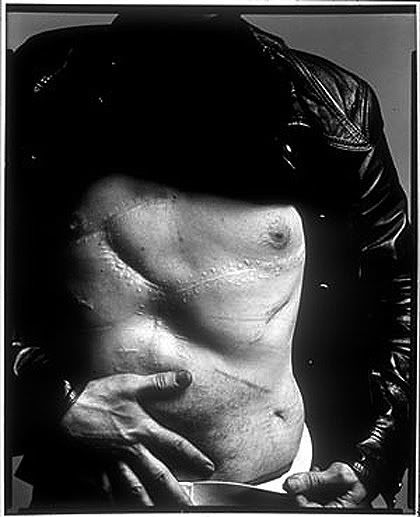
Richard Avedon’s portrait of Warhol imposes a particular/directed reading
And: Unprompted promotional charity on the Internet, self-demeaning jocularity, promise of one lucky winner, praise for a particular play, events punching beings, an Appalachian whorehouse, Shakespeare’s contemporariness, lyrical rhizomatic explosions, postcard biographies, the critical treatment of the life of Andy Warhol, a sculpture made out of information in the shape of its subject, the centrality of absence, an anecdote about identity...
1. The Corresponding Society is giving away a copy of the first issue of Correspondence for fun. This is called promotion, I guess, I’m not sure. To qualify, all someone has to do is read this very entry we have posted on our Internet blog (I pray that qualifies at least one lucky so-and-so) and be the first to send us an email informing us that she is the winner (whereupon we will happily mail out her spoils gratis [though in the more likely event that she is somebody we know and see on a daily basis, who has just avoided spending money on a copy, we’ll just deliver it personally]). We wish every one of the many devotees of this Internet presence the best of luck in this matter.
2. The Corresponding Society urgently implores all residents of New York City to make reservations to see the play Twelve Ophelias, written by Caridad Svich and presented by the Woodshed Collective. It’s playing through August, with free admission, at Williamsburg’s delightful McCarren Pool. The production has systematically astonished just about every available member of The Corresponding Society recently. I saw it first knowing nothing about it⎯it’s just one of those things, those serendipitous events that punch your being unexpectedly. Quite loosely, the conceit involves Ophelia resurfacing to find herself in an alternate existence where Elsinore is a whorehouse in Appalachia and Hamlet is a backwoods miscreant called the Rude Boy. No other recent production predicated upon Hamlet has proven how alive Shakespeare’s play still is, how important, how adaptable. As a writer who has been closely studying Hamlet for over a year, it was an indescribable experience watching the play I love and know so well breathing inside and through a new body. Hamlet is ours, Hamlet is depthless, and this interpretation lyrically explodes Hamlet rhizomatically. Also, it’s a musical.
3. Michael Kimball, author of the new novel Dear Everybody, is also a prolific biographer who writes the life stories of strangers on the backs of individual postcards; recently he profiled the poet Lonely Christopher (though forwent mentioning the subject’s status as web editor of The Corresponding Society) on his blog. To segue awkwardly into the more appropriate use of first person when referring to myself, I was intrigued to participate in this project. When my postcard biography arrived in the mail my reaction was decidedly mercurial, but as a dedicated reader of books on the lives of others I have come to understand and accept that biography is an art of interpretation: a writer doesn’t explicate the life of his subject, he performs it. I recently read two biographies of Andy Warhol, one by Victor Bockris and the other by Wayne Koestenbaum. The former, thicker and more grounded, posed as an objective account of a life but implicitly failed to avoid shaping the Warholian data into a writerly narrative necessitating judgment, a sculpture made out of information and opinion shaped like its subject. The latter was far more flamboyant about its distance from a definitive conception of Warhol; Koestenbaum knew he couldn’t reconstruct his subject in facsimile⎯so he took the available data and thoughtfully used it to build a structure around the absence. When I read my own abbreviated biography I saw Kimball performed a reduction of the accumulation of source data, like a sculptor addressing a block of marble (or maybe a preexisting, larger, and more detailed marble statue), to narrow and redefine my self-narrative into his narrative of my self as his subject. The extremely compact nature of this project is illustrated by how, ultimately, my biography is reduced to a list of drastic labels perhaps meant to suggest taxonomy (ergo I am summarized with words that imply concision yet are calculated to corroborate the stance of the whole piece). While some of what he posits upsets me or strikes me as a misreading (“As a form of self-medication, he started drinking as a high school freshman.”), there is at least one imposition of causal narrative that I found illuminating (“In kindergarten [he] couldn’t tell the difference between writing and drawing, which still influences his approach to writing.”). To put it differently, allow me to retell (rewrite, perhaps, or write) an anecdote from Bockris’ treatment of Warhol without having the text available for reference. Warhol lived with his mother Julia Warhola in New York City; perhaps he mistreated her, perhaps she was taken to drink. Maybe there was an argument and Julia’s resultant departure from the house, whereupon she returned to Pittsburg where she had raised Andy and his brothers. Consequently, Andy’s household might have fallen into neglect (presumably because Andy was helpless without his mom). Julia was probably convinced to come back by those concerned with her son’s welfare, and she did come back, but when she did she stormed into the apartment, threw her suitcase angrily down, and, in front of her son and most likely some of his close friends, declared of herself, “I’m Andy Warhol!”
Subscribe to:
Posts (Atom)